
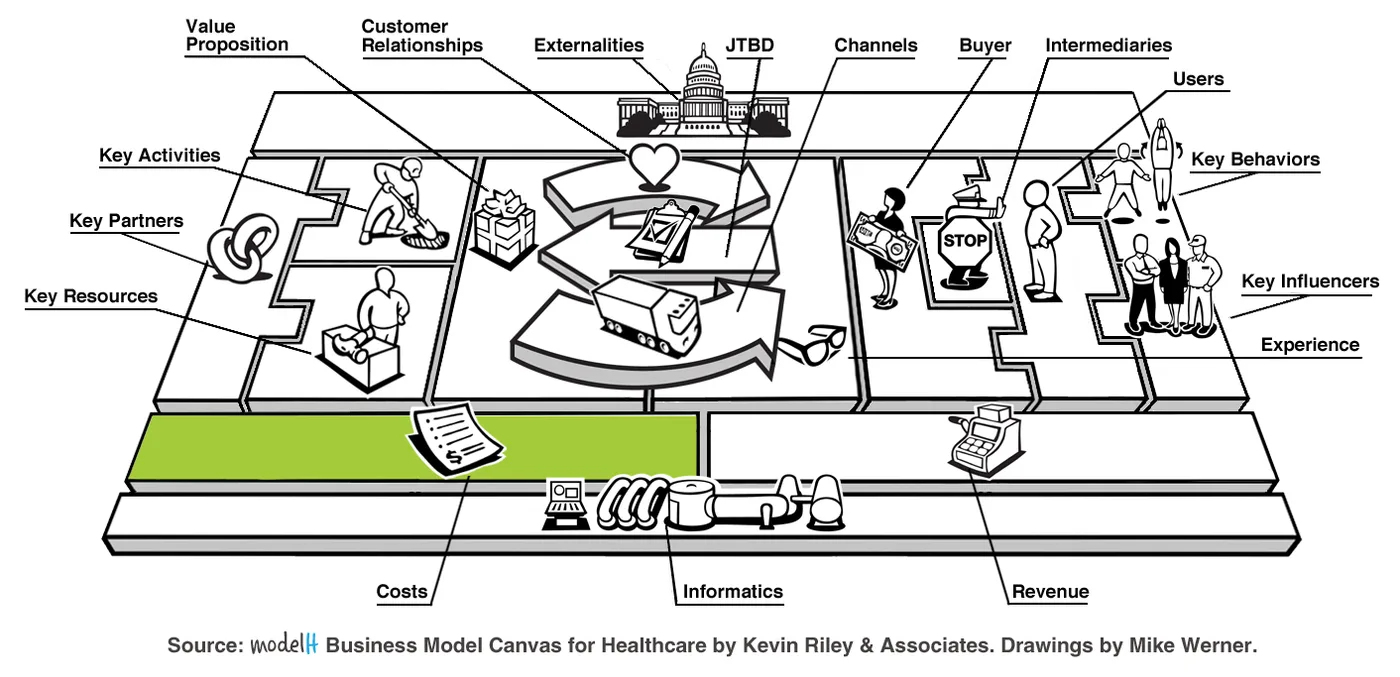
modelH Business Model Canvas: Costs
Costs are the most important financial drivers of a business model. There is a case that Costs are the most important of all the healthcare building blocks, because the U.S. spends far more of its GDP on healthcare than peer countries do, and it is hard to tell the good costs from the bad.
It comes back to Porter's definition of value: outcomes per dollar. Your model should reduce the aggregate cost of care, not just move it around.
Questions for the Costs Block
- What are the most important fixed Costs?
- What are the most important variable Costs?
- What drives them, and which are controllable?
- Which can be reduced through economies of scale or scope?
- Which Channels and Customer Relationships are most expensive?
- Which Key Behaviors, Key Resources, and Key Activities are most expensive?
Know Your Numbers
You have most of what you need in your P&L: Revenue, Cost of Goods Sold (in care delivery, your actual medical cost), Gross Margin, Operating Costs, Operating Income, and Net Income. Your base includes salaries, professional fees, rent, utilities, depreciation, interest, and maintenance. Then add what is specific to your industry, like claims incurred but not reported for insurers.
Build a budget, track actuals, and repeat for as long as you run the business. Also compare your costs with the cost of doing nothing, for the User, Buyer, and system. If your model is cheaper only for you, question its value.
Having started several healthcare companies, some successful and some not, my advice is simple. Bring in a qualified financial expert who knows your business, and do it from the start.
Beware the Systemic Cost Trap
Your model might lower your own costs and raise total costs.
- If you find more problems, you may create more follow-up, some valuable and some not.
- If you add a new service without removing an old one, you have added cost, whatever your slides say.
- If you save money only by moving work to patients or staff, the cost has moved rather than gone away.
Ask who actually keeps any savings. Under fee-for-service, productivity may simply raise volume. Under risk, savings can fund care.
What is Next?
Next, we look at the other side of the ledger: Revenue.
to your health,
Kevin