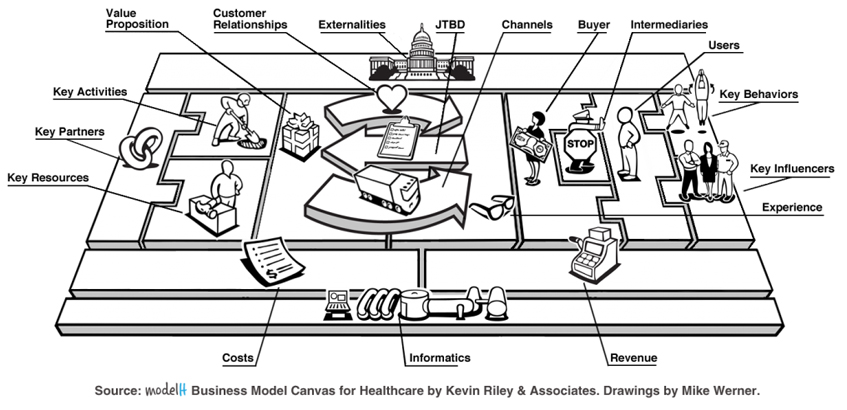
A business model canvas is a strategic management template for developing new business models, or documenting existing ones, in a visual language. It shows how a business's activities line up to produce value, and makes the trade-offs visible.
modelH is a business model canvas designed specifically for healthcare and life sciences. It gives teams a common language for describing, visualizing, assessing and changing the key elements of a healthcare or life sciences business model. It is complex enough to evaluate an entire business model, and simple enough for every part to be understood.
Expanding on Alex Osterwalder's original 9 building blocks, modelH integrates Michael Porter's definition of shared value and Clayton Christensen's concept of jobs-to-be-done. It measures a business model both on its ability to deliver value and on the patient health outcome it achieves per healthcare dollar spent.
Why modelH
Healthcare business models have more sides than most
Osterwalder's Business Model Canvas is one of the best ways to describe a business model, but healthcare is multi-sided. The person who uses a service is often not the one who pays for it, and someone in between shapes both. modelH expands the nine original blocks to 17 so those relationships show up on the canvas.
Users are not always buyers
A patient uses the service; a health plan or hospital buys it. modelH splits Customer Segments into Users and Buyers so each gets its own value proposition.
Intermediaries shape the deal
Brokers, benefit managers and referral sources change how a value proposition is seen and paid for. They get their own block, along with Key Influencers.
Value is measured in outcomes
Built on Clayton Christensen's jobs-to-be-done and Michael Porter's shared value, modelH asks what health outcome a model achieves for every dollar spent.
“Value is the patient health outcome achieved per healthcare dollar spent.”Michael Porter, the definition of value modelH is built on
A good healthcare model moves the quintuple aim
ExperienceBetter patient experience of care, including quality and satisfaction.
HealthBetter health for the population.
CostLower per capita cost of care.
CliniciansValue created without over-burdening providers.
EquityHolistic, equitable access to care for everyone.
The 17 building blocks
Working through the blocks in order helps you think about each one's strengths and weaknesses, and how the blocks fit together. Use modelH to design, describe, challenge, invent and pivot your healthcare or life sciences business model.
Customers
1Users Users are the customers that a business model serves.
2Buyers Buyers are the customers a business model sells to, and may also be the User.
3Intermediaries Intermediaries affect how a Value Proposition is seen and paid for by the Buyer.
4Jobs-to-be-Done Jobs-to-be-Done (JTBD) are high-level goals the customer is trying to accomplish.
6Key Behaviors Key Behaviors are the activities required of the User to complete their JTBD.
7Key Influencers Key Influencers affect the User's understanding of and ability to complete their JTBD.
Products
5Value Proposition Value Propositions are products and services offered to customers to solve their JTBD.
8Channels Channels are the way a company brings its Value Proposition to market.
9Customer Relationships Customer Relationships are connections a company creates with their Buyers and Users.
10Experience Experience is how Buyers and Users perceive Channels and Customer Relationships.
Operations
11Key Activities Key Activities are the most important tasks required to create the Value Proposition.
12Key Resources Key Resources are the internal actors required to deliver the Value Proposition.
13Key Partners Key Partners are the external actors required to deliver the Value Proposition.
16Informatics Informatics is the data and analytics needed to deliver the Value Proposition.
Financials
14Costs Costs are the most important financial drivers of a business model.
15Revenue Revenue is the way a company makes money from its customers.
Context
17Externalities Externalities are the external forces and regulations imposed upon a business model.
Built in the open
Co-created by 300+ people across healthcare
modelH started in 2012 as a year-long co-creation forum. More than 300 clinicians, payers, founders and innovators worked through Osterwalder's canvas block by block, debating what healthcare needed. Some blocks were kept, some dropped, some combined and some split. The result was released under Creative Commons, and universities now use it to teach healthcare and entrepreneurship.
The canvas was developed by Kevin Riley, with drawings by Mike Werner. To learn how to fill in each block, read the modelH blog.