
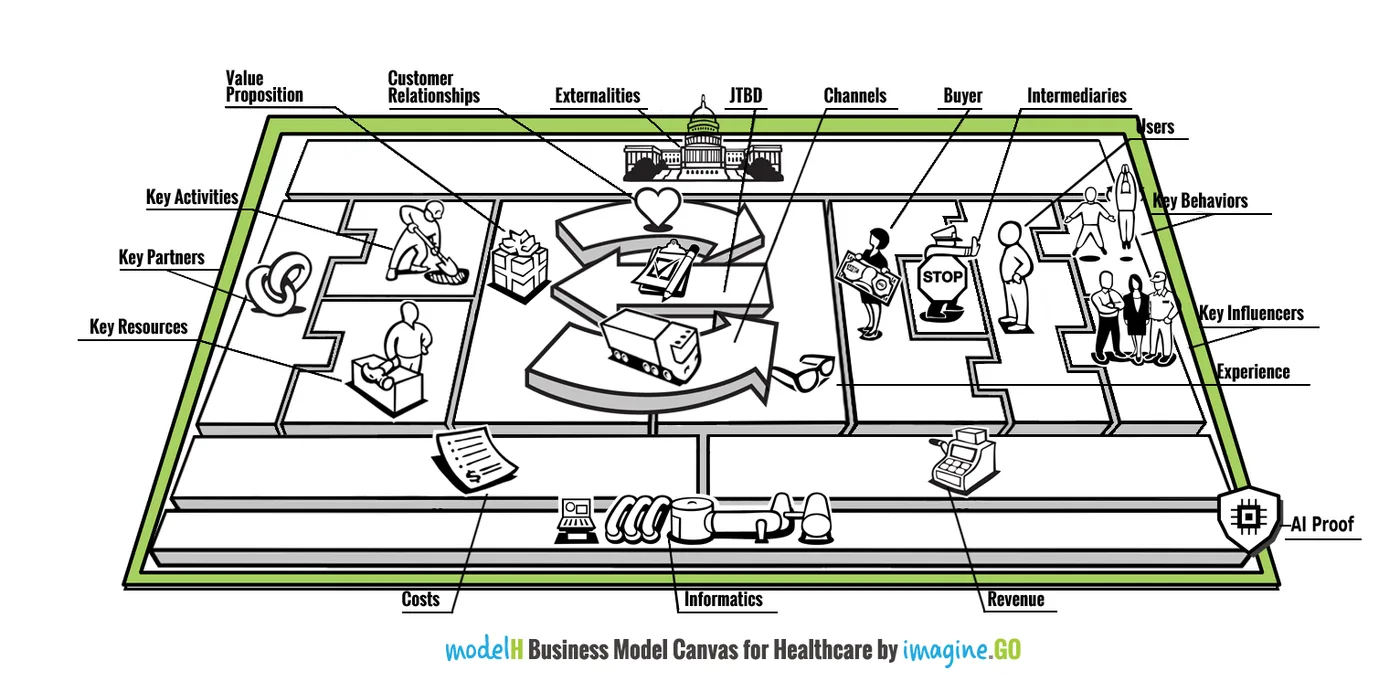
modelH Business Model Canvas: Block 18, AI Proof
I do not add blocks lightly. We spent a year arguing about the first 17, and people I respect thought that was already too many. So let me apply the same two tests I used in 2013. Does this affect the business model? Is it needed to explain how the model works?
For the first time in the history of this canvas, the answer is yes for something that cuts across all the others. Every block can look fine on its own while the company as a whole is becoming obsolete. So here is the new block.
AI Proof is how a company becomes AI-native in how it works, then AI-proof in how it makes money.
It is two stages, in order.
Stage 1: Become AI-Native
AI-native does not mean you bought licenses or have a pilot. It means that if you lost AI tomorrow, you would have to reorganize the company.
Here is what it looks like.
- The work is redesigned. Key Activities are built assuming AI, rather than adding AI to the old process.
- Everyone uses it. It is part of how each function works, from clinical to finance. Leaders use it themselves.
- Accountability is clear. Each AI system has an owner, a scorecard, and an escalation path.
- Data is ready. It is accessible, permitted, governed, and connected to outcomes.
- Learning is fast. You can test, measure, and change in weeks.
- Safety is built in. Governance speeds you up because people trust what ships.
Why first? Because you cannot judge what will last until you know what the technology can do. Leaders who have not rebuilt real work with AI tend to overestimate it in the boardroom and underestimate it on the front line. You also need the savings and speed to fund what comes next.
But being AI-native is not a defense. Your competitors will be AI-native too. It may simply get you to the point of being a very efficient company that sells something nobody needs any more.
Stage 2: Become AI-Proof
AI-proof does not mean immune to AI. Nothing is. It means your reason for existing gets stronger as AI gets better and cheaper.
Here is the test. Imagine a world where every competitor has the same models you do, your customer has a free assistant that can do most knowledge work, and models get twice as good next year. Why would anyone still pay you?
Some healthcare answers hold up. These are the sources of durability I would bet on.
- Accountability. You hold the license, sign the note, carry the malpractice exposure, or stand behind the result. Software cannot be held responsible. Someone must be.
- Risk-bearing. You take financial risk for a population's outcomes. Better AI makes that position more valuable, as you keep the savings.
- Proprietary, compounding outcomes data. You know what you did and what happened to the patient, and you have the rights to learn from it.
- Physical presence. Hands, procedures, labs, homes, and clinics. Atoms take longer to automate than words.
- Evidence and regulatory position. Trials, clearances, and real-world proof take years and money, however good the model is.
- Trust and relationship. People choose who to believe with their health, and they do not choose lightly.
- Distribution and workflow position. You are where the decision happens, with permission to act.
These answers do not hold up.
- "We have proprietary AI" when you are wrapping a model anyone can rent.
- "We make the work 30% faster" when your customer's platform is about to do the same.
- "We explain complexity" when explanation has become free.
- "We have a head start" with nothing that compounds.
The AI Proof Map
Place each of your Revenue lines on two questions.
- Does AI make this cheaper to deliver?
- Does AI make this easier for someone else to deliver or for the customer to do themselves?
If AI lowers your cost but not your defensibility, that is a harvest. Take the margin while you can, and invest it. If AI lowers both, that is a melting line. Plan your exit or your pivot. If demand grows as AI improves, say because more diagnosis means more treatment, that is an engine. Put your best people there.
Questions for the AI Proof Block
AI-Native
- What would break if we lost AI tomorrow? If nothing, we are not AI-native.
- Which Key Activities have been redesigned, not just assisted?
- Who is accountable for each AI system, and what is on its scorecard?
- How quickly can we test and change something?
- Do our leaders personally use it for real work?
AI-Proof
- If every competitor had our AI tomorrow, what would we still have?
- If our customer's own AI could do this job, why would they still pay us?
- Which of the seven sources of durability do we actually have?
- Which Revenue is melting, and how quickly?
- What gets stronger for us when models improve?
How It Plays Out by Stakeholder
- Patients and consumer companies: information is free. Durability sits in trust, care access, and outcomes.
- Providers: the license, the hands, and the relationship are strong. Fee-for-service productivity gains may be competed or contracted away. Risk contracts let you keep them.
- Payers: administrative advantage shrinks when everyone automates. Durability sits in risk management, networks, and member trust. Expect tough questions if AI is seen as a denial machine.
- Purveyors: evidence, regulatory position, manufacturing, and clinical data hold up. A discovery advantage may be shared quickly. A drug that works in patients is still the point.
- Digital health and AI vendors: the most exposed group, and the one with the most to gain from moving from tool to accountable service.
A Caveat, and My Own Humility
"AI-proof" is an aspiration, and I chose the phrase because it is clear. No company is ever finished. Revisit this block every quarter, since the answer will change. I am also sure that some of what I list here will look wrong in two years, and I invite you to tell me so. modelH was built through argument, and I would like that to continue.
What is Next?
One final post to bring all 18 blocks together.
to your health,
Kevin