
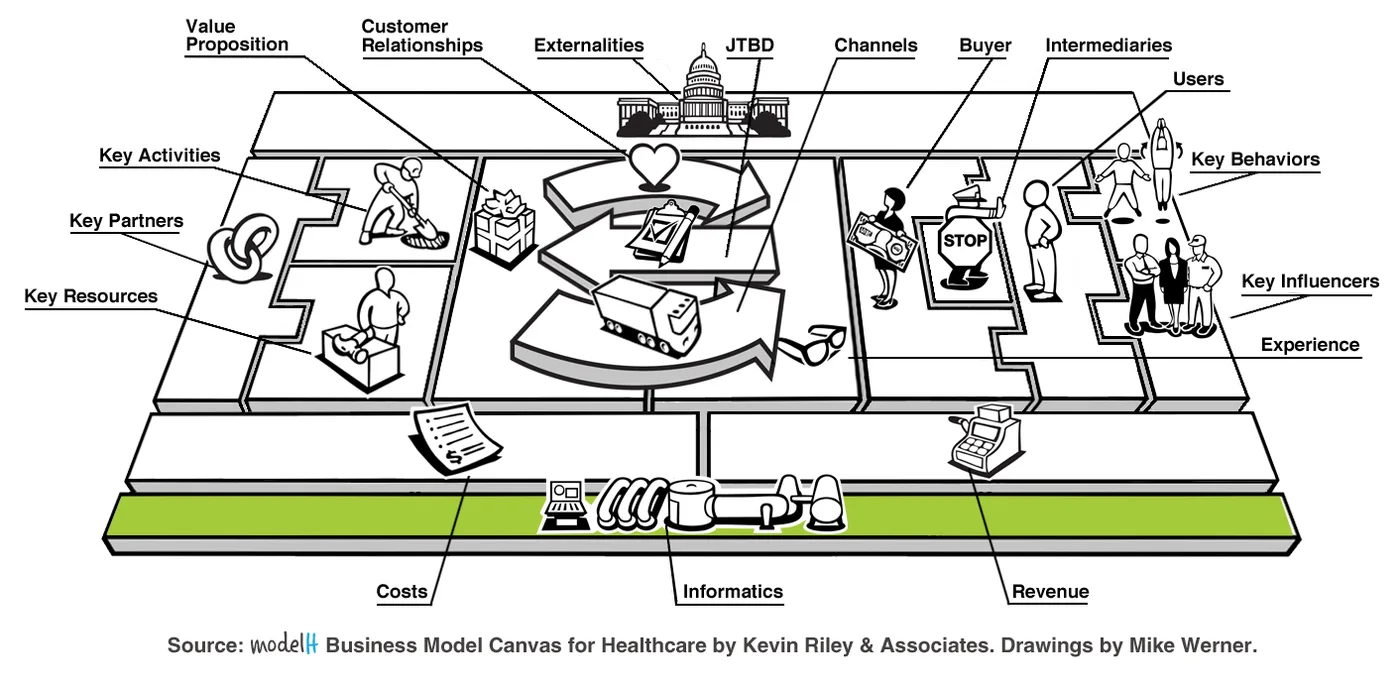
modelH Business Model Canvas: Informatics
Informatics is the data and analytics needed to deliver and measure the Value Proposition. Most business model canvases do not call it out as a block. I insisted, because I cannot believe a business model is viable unless I know how its success will be measured.
Here was the 2013 argument. Measuring Revenue and Costs is good governance. But even if you are making money, if you are not measuring your Value Proposition's fit with the JTBD, you are open to disruption. The whitespace between what you offer and what customers need is the Blue Ocean of your business model. Either you explore it, or someone else will.
In 2026, this is the block that has changed the most.
Questions for the Informatics Block
- What data is derived from Buyer and User interactions?
- What systems are needed to capture that data?
- How does the model gain and use insight from those interactions?
- How does this insight improve Product-Market Fit?
- How does it improve your Behavioral Economics?
- How does it drive additional Revenue?
- How does it lower Costs?
From Dashboard to Decision to Action
I think of Informatics in four stages.
- Measure: what happened?
- Understand: why did it happen?
- Recommend: what should we do?
- Act: do it, within agreed limits, and report back.
For most of healthcare's history, we got stuck between steps 1 and 2. AI moves us toward 3 and 4, and that raises the bar for everything underneath. A bad report wastes an hour. A bad autonomous action can hurt someone.
What AI Unlocks
Unstructured data finally counts. Much of what matters is trapped in notes, faxes, images, and recordings. Models can read it, turning old filing cabinets into usable assets. Treat the output as a draft until it is validated.
Conversation becomes data. Every chat and call reveals jobs, pains, and barriers. That is continuous Customer Discovery, if you have consent.
Questions get easier to ask. Anyone can ask a data question in plain English. So everyone can also get a confident answer from bad data. Definitions and data governance matter more, not less.
What Must Be Measured Now
Your AI needs its own scorecard alongside your business KPIs and OKRs.
- Performance: accuracy on your own population and data, re-tested over time.
- Fairness: results by population, language, and setting.
- Safety: errors, near misses, and what happens when the system is unsure.
- Human oversight: how often people override it, and whether they still look.
- Value: did the outcome or the cost change, compared with a baseline?
- Unit economics: cost per completed job, not just per token.
The last two are the ones most companies skip. Consider ambient scribes: results range from 16 fewer documentation minutes per eight hours to vendor-style claims of an hour or more a day. Believe your own measurement.
Federal policy is moving this way too. FDA's final 2025 guidance on Predetermined Change Control Plans and its draft lifecycle guidance both look past the first authorization of an AI-enabled device. Assume you will need to prove performance continually.
Data as a Moat, Honestly
Everyone says data is their moat. Test it. Data is a moat only if it is proprietary, you have the rights to use it, it improves the product or decision, it is expensive to replicate, and it stays fresh. A pile of old claims that a dozen others also have is not a moat. A continuous feedback loop linking what you did to what happened to the patient may well be one. That is the data AI cannot generate for itself.
All of this rests on trust. To get the data, present a legitimate reason for each element and tell people what it is used for.
New Questions for 2026
- At what stage are we: measure, understand, recommend, or act?
- What is on our AI scorecard, and who reviews it?
- Do we connect AI activity to outcomes against a baseline?
- Is our data truly a moat by those five tests?
- Do we have the rights and consent for what we plan to do?
What is Next?
We wrap up the How.
to your health,
Kevin