
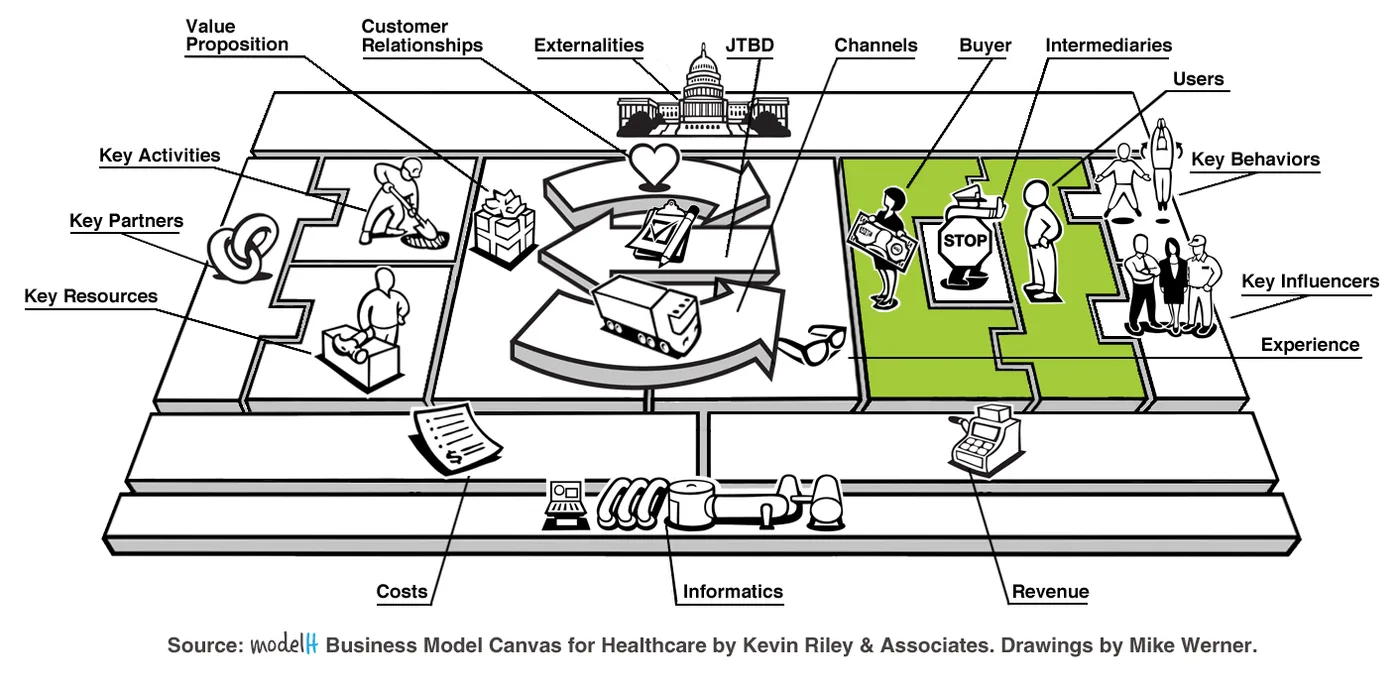
modelH Business Model Canvas: Customer Segment
Our premise is simple. If it were well understood and consistently executed, fewer healthcare companies would go belly-up.
- If you know your customers,
- you can get them what they want,
- and delight them in the process.
- Then repeat step 1 to see how things have changed.
In modelH, we break customers into three categories.
- Users are the customers that a business model serves.
- Buyers are the customers a business model sells to and may also be Users.
- Intermediaries affect how a Value Proposition is seen and paid for by the Buyer.
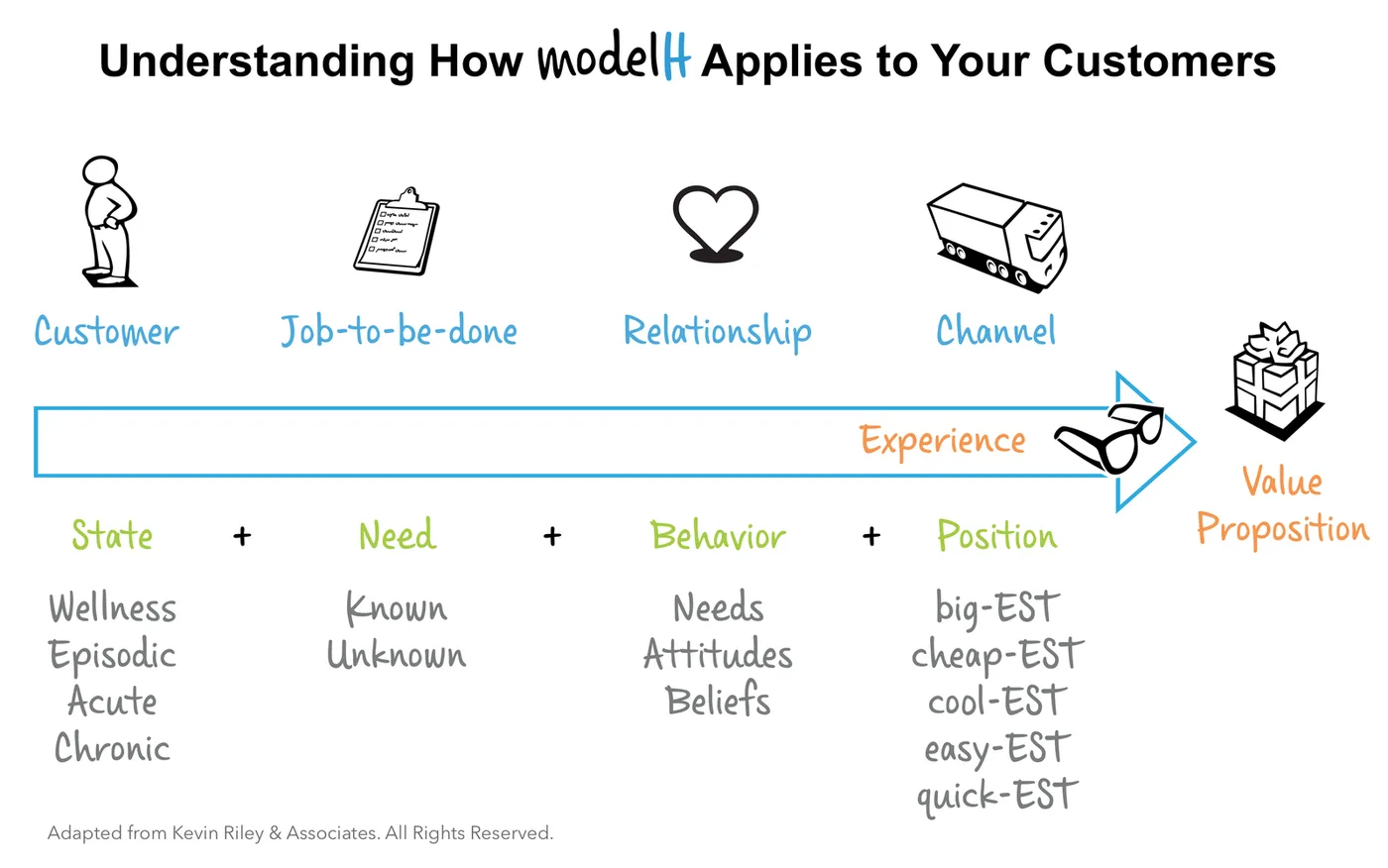
You Are Not Your Customer
As Steve Blank put it, your office lacks market facts. It is merely where you guess what customers want. Customer Discovery is the work of designing experiments that replace those guesses with evidence.
AI makes this trap more dangerous. A model can now generate a convincing persona, a market summary, and a list of customer pains in about a minute. All of it will sound plausible, and none of it is evidence. Use AI to prepare for customer conversations and to analyze the transcripts. Do not let it stand in for the conversations.
Your Users
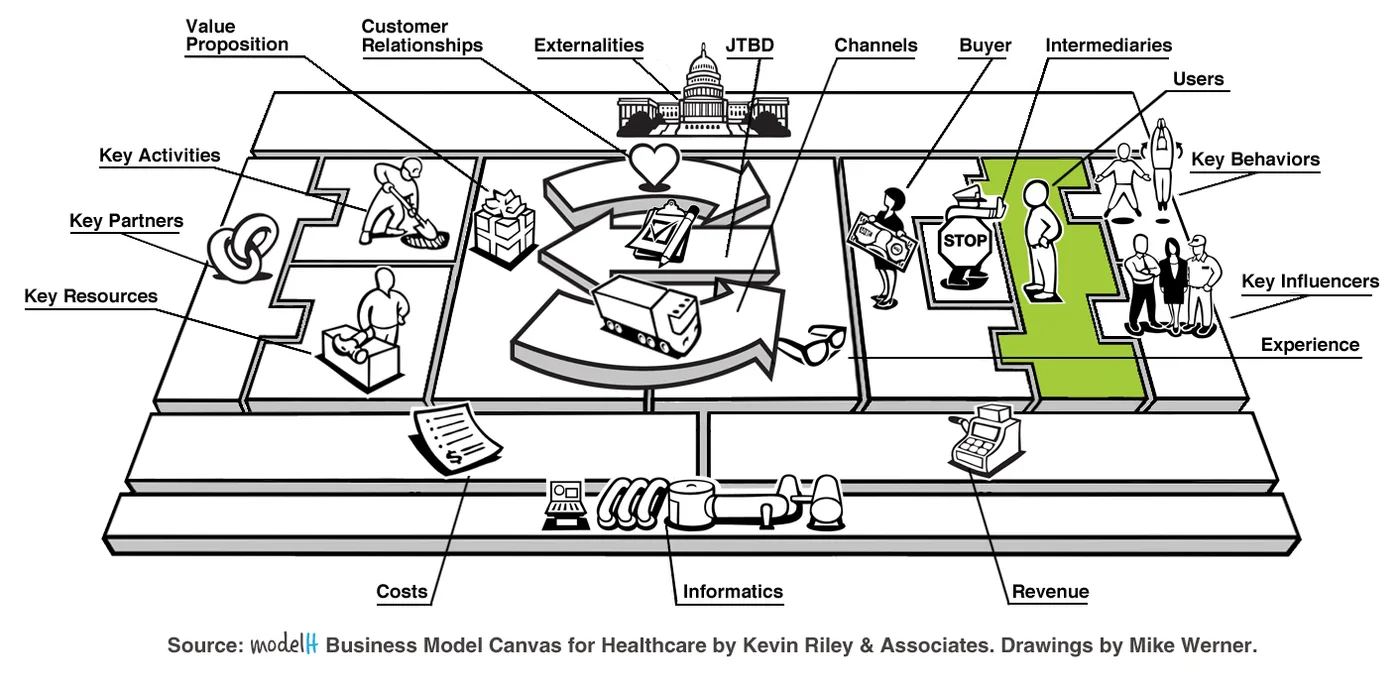
modelH Business Model Canvas: Users
You are not your Users. At a healthtech company, you are more technologically sophisticated than your customers, and your closeness to the product hides problems that are obvious to a first-time user. Unless you have lived with the patient's condition, you only partly understand their situation. Nurses grasp this well. Developers often do not.
Here is the 2026 change: your User may arrive already advised. In one Rock Health survey, health chatbot use doubled in a year. So a patient may reach you with an AI's explanation of their lab results, and a care manager may reach you through an AI copilot inside their workflow. And your product may increasingly be used by another piece of software acting on someone's behalf.
That raises a question I never had to ask in 2013: who, or what, is actually using your product?
Your Buyers
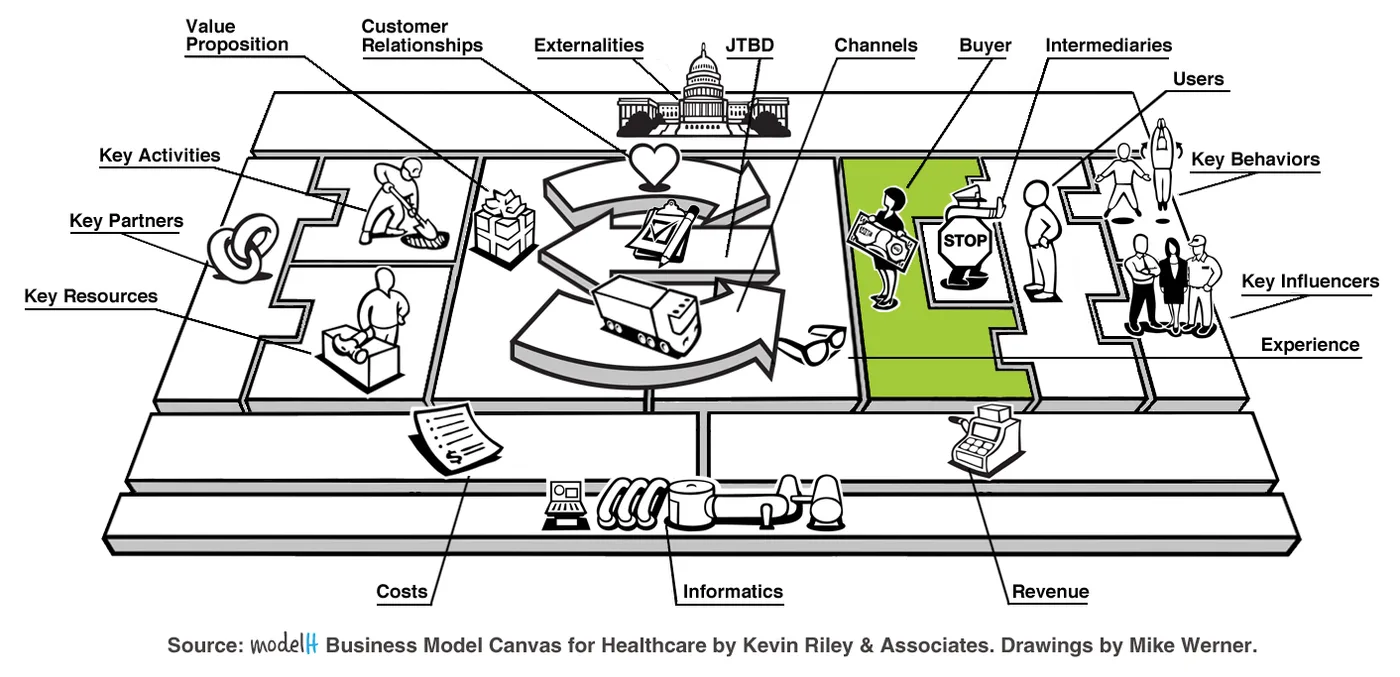
modelH Business Model Canvas: Buyers
You are not your Buyer, either. Buyers do not care what your product does well or whether fancy AI is included. They care how well it solves their problem compared with the alternative.
The alternative has changed. Your Buyer now compares you with the AI feature in their EHR, a general-purpose model their staff already use, and something their own team might build. The question has become: what do you do that I cannot get elsewhere for free?
In B2B sales, the final decision maker usually sits a few levels above the User and cares about return on investment rather than the interface. For AI products, add the people who can stop the deal: compliance, security, legal, and clinical governance. They are part of your buying journey now.
Your Intermediaries
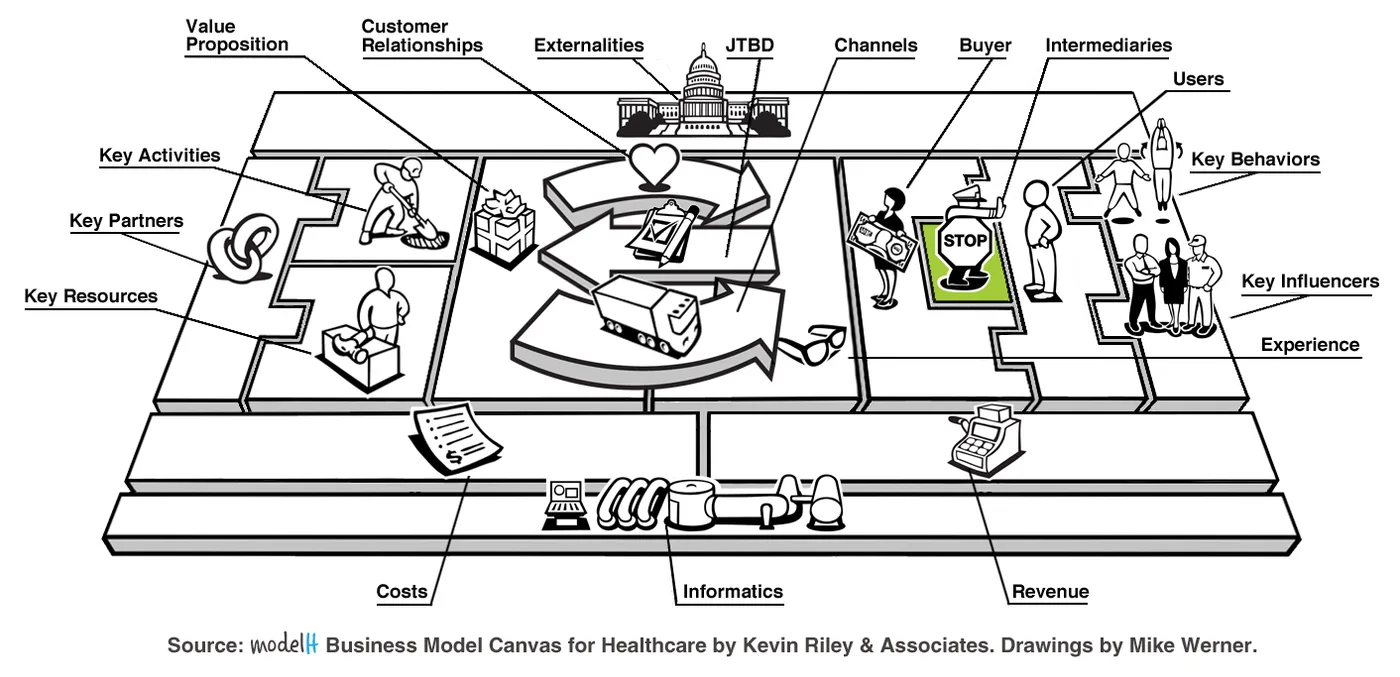
modelH Business Model Canvas: Intermediaries
Healthcare is a multi-sided market. Four players interact through a physical or digital platform to receive value.
- Patients seek care, medications, and equipment.
- Providers deliver care.
- Payers finance all or part of it.
- Purveyors supply the goods: pharma, device makers, and data firms. (Yes, it is an onerous word. I love alliteration.)
Each relies on the others. Intermediaries live between them. They are not all bad, and many exist because a business model has a flaw or a constraint that someone must manage. The test remains: if the Intermediary benefits before the User or Buyer, it is at odds with the Value Proposition.
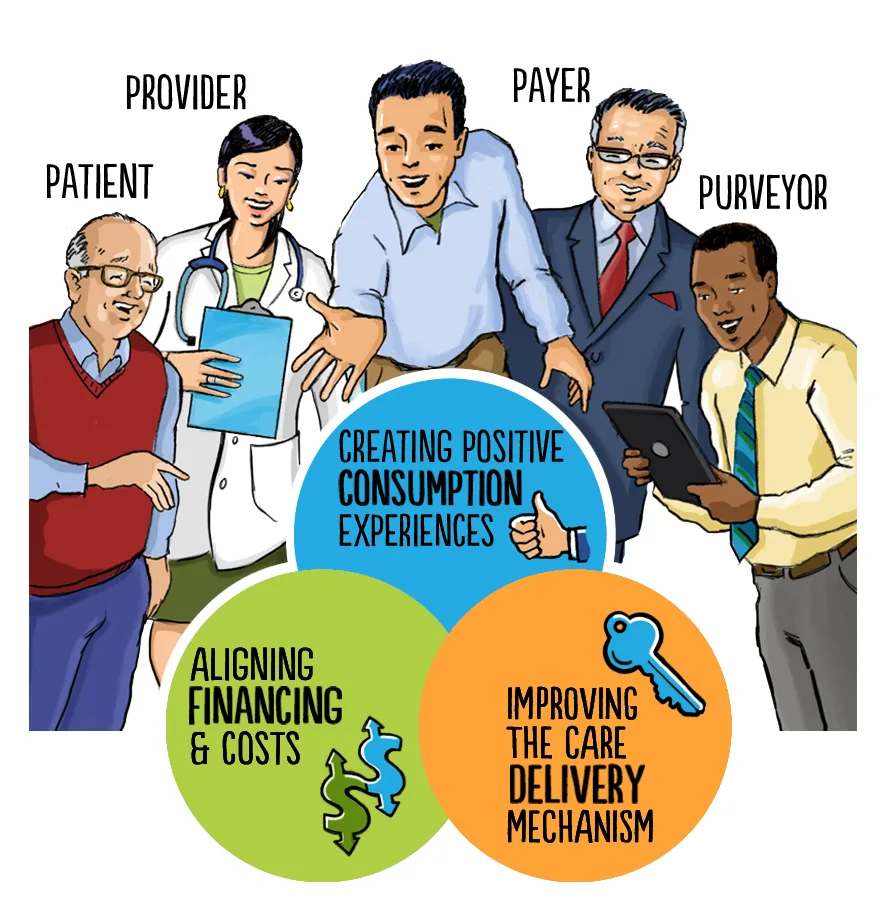
modelH: Healthcare Ecosystem
AI matters here because it attacks what many Intermediaries sell, which is the ability to make sense of complexity. We go deep on that in post 5.
In Summary
Do not run around yelling VBC and AI without developing a model that drives value to a defined customer. Know your User's background, concerns, and preferences. Consider culture, language, and health literacy so you are equitable in your approach. And if you are in this business, be in it for better health outcomes. Don't be a pharma bro, please.
New Questions for 2026
- Who, or what, actually uses our product: a person, a person with a copilot, or an agent?
- What does our User already believe when they arrive, and where did they get it?
- What is our Buyer comparing us with now, including free and built-in AI?
- Who outside the budget owner can veto an AI purchase?
What is Next?
Next, we define Users and Buyers on the canvas and size the market.
to your health,
Kevin