
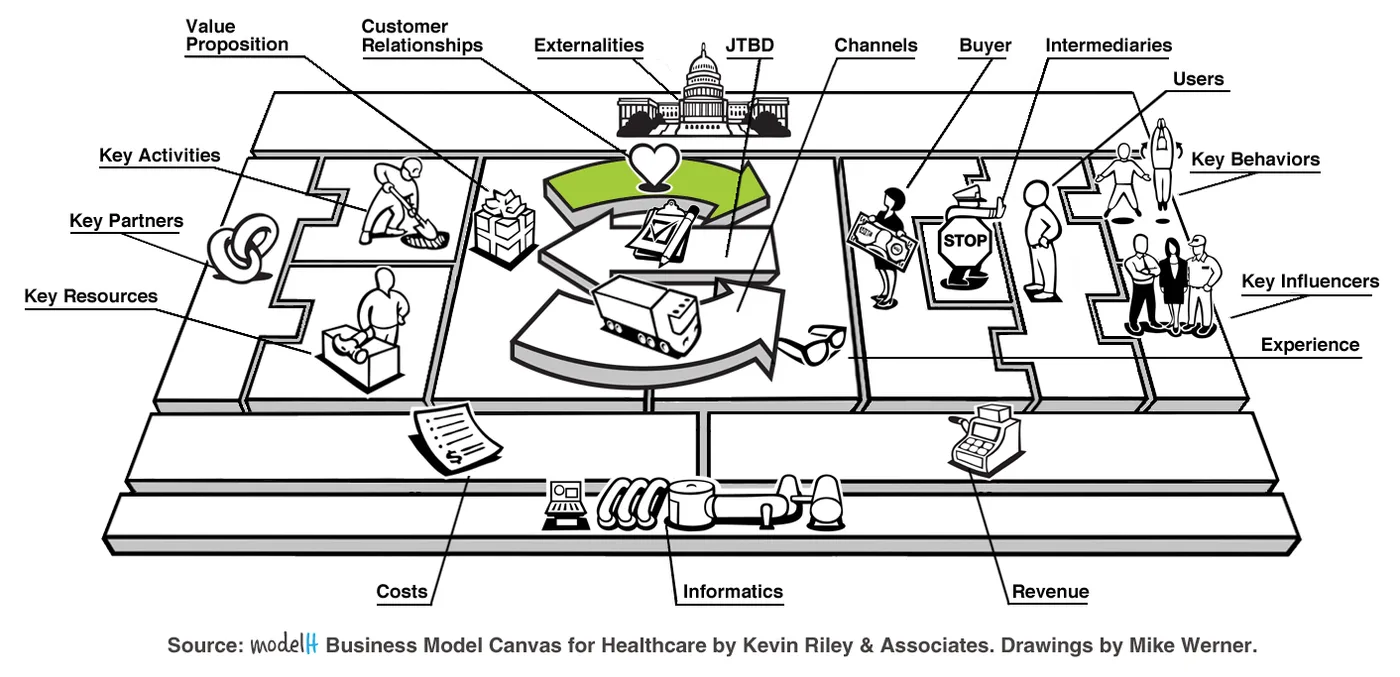
modelH Business Model Canvas: Customer Relationships
Customer Relationships are the connections a company creates with its Buyers and Users. If my tax advisor can explain healthcare reform to me in simple terms, why can't my health insurance company? If my phone company can send me a personalized video bill, why am I still getting an unreadable explanation of benefits? Every touch improves, maintains, or weakens a relationship.
Osterwalder's canvas lists five forms: personal assistance, dedicated personal assistance, self-service, automated services, and communities. AI blurs all of them. Automated service can now feel personal. Self-service can have a conversation. That forces a decision you could once avoid: which relationships should feel human, which actually need to be human, and how do you stay honest about the difference?
Questions for the Customer Relationships Block
- Which Healthcare Customer Relationship Dimensions does your model use?
- What relationships do customers expect you to maintain?
- How costly is each to maintain?
- How will you market your Value Proposition to consumers?
- When a customer has a positive Experience, how will they share it?
- How will you receive feedback and act on it?
- Who is the greatest Key Influencer, and how will you use them?
- How will you get, keep, and grow customers?
The Seven Dimensions
modelH says healthcare relationships have seven fundamental dimensions, used in varying degrees. In each, customers have preferences for channel and message, and they usually need emotional support and physical comfort. Here is each with its AI implications.
- Information: content that helps solve the JTBD. General information is now free, so your value lies in what is specific, current, and accurate for this person.
- Navigation: guides people toward new, positive choices. AI can create a personal action plan. Accountable humans take over for hard cases.
- Coordination: simplifies logistics, such as appointments, records, and alerts. This may be AI's best fit, since agents can do real work here.
- Connection: links people to others and to complementary solutions. Use AI to strengthen human bonds. Be wary when it replaces them.
- Transition: keeps relationships strong across Channels, partners, and care settings. Discharge and handoffs are where care breaks down, and summaries help.
- Motivation: creates and sustains change, including incentives and rewards. AI can tailor it. Behavior still takes a person's will, and often another person's encouragement.
- Monetization: turns the relationship into a sustainable business. Be clear about who benefits. If AI talks to patients and your Revenue depends on what they buy, disclose it.
A Rule of Thumb: Consequence and Emotion
When deciding how to use AI in a relationship, ask two questions.
- How serious are the consequences if this goes wrong?
- How emotional is this moment for the customer?
Low on both, like rescheduling a visit? Automate it, and most people will be grateful. High consequence but low emotion, like reviewing a medication list? Have AI prepare it and a person check it. Low consequence but high emotion, like a frustrated member with a small bill? Let AI gather the facts and let a person show up. High on both, like a cancer diagnosis or a denial of a needed treatment? A person leads, with AI behind the scenes.
This also applies to Buyers. A health system CIO evaluating AI does not want a chatbot as an account manager. They want someone who will answer for the product when it fails.
How to Measure Relationships
Move past call volumes and resolutions. Add Revenue and Cost.
- Revenue and cost: cost to serve by Channel, cost over revenue, and conversion from reach to lead to customer.
- Loyalty: retention, referrals, satisfaction, and Net Promoter Score.
- Effort: Customer Effort Score, speed of resolution, complaints, and kudos.
- Comprehension: did they understand, and did they follow through?
Add two for AI. First, trust after an error: do customers come back after AI got something wrong? Second, health outcomes: did the relationship change anything that matters?
New Questions for 2026
- Which relationships should remain human, even when AI could do them more cheaply?
- Who answers when AI gets it wrong?
- Are we honest about when the customer is dealing with AI?
- Does AI free up our people to spend more time with customers, or just reduce headcount?
What is Next?
We wrap up the What.
to your health,
Kevin