
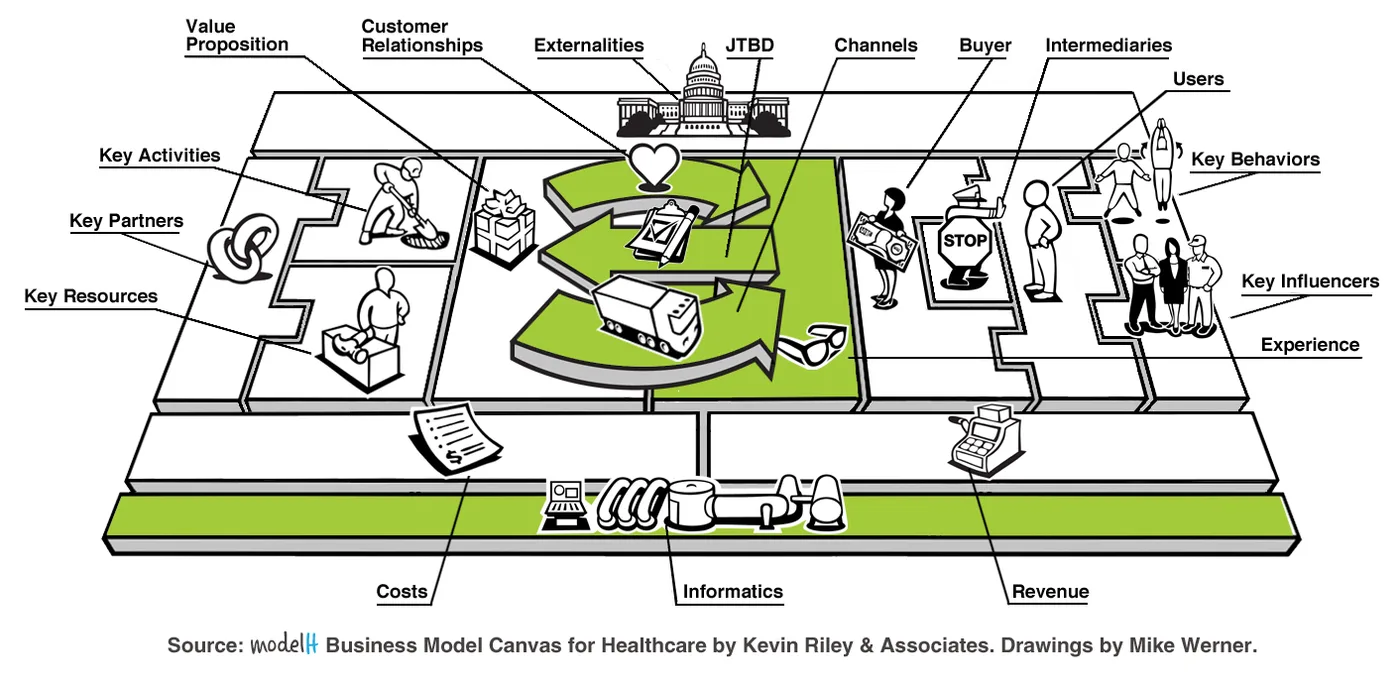
modelH Business Model Canvas: Channel Threading
Customers use many Channels to decide on, buy, and use a Value Proposition, and they expect you to behave like one company across all of them. Channel Threading is the intentional connection of multiple Channels with an understanding of how they combine to complete an outcome for the Customer Segment.
Done well, it links Channels in a meaningful way and allows personalized products and messaging. Done badly, you ask a patient for their date of birth four times in one phone call.
The Two Halves of the Journey
Healthcare journeys have two parts: the purchase and the use of the purchase. Both matter equally, but they do not get equal treatment. Traditionally, far more time goes to the sale than to the use. In value-based models, the use is where you get paid.
How to Thread Your Channels
- Start with the JTBD at each stage of the journey.
- List every Channel a customer could use, inside and outside your control.
- Consider fit by product, customer, profitability, and sales goals.
- Draw the actual journey across Channels. We use a Hassle Map, meaning the steps that characterize the customer's Channel experiences in completing their JTBD.
- Create the desired threads by closing the gaps. Accentuate what works and fix the negatives that matter most. Take an MVP approach, since you can only do so much and customer expectations change as they acclimate. Think of how banking moved from branches to online.
- Say what is left out, so manual work-arounds can be developed and communicated.
- Build the development plan with Channel owners and other stakeholders.
The foundation is simple to state and hard to do: same customer, same data, same message.
What AI Adds to the Thread
Memory across Channels. An AI layer can summarize what happened on the last call, the portal, and the visit so that the next person, or agent, picks up where things stopped. Nobody starts over.
Understanding of what the customer meant. AI can read a free-text message and route it correctly rather than forcing the customer through a phone tree.
Warm handoffs. The handoff from bot to human used to be a cliff. Now the agent can pass along what it learned and what it tried. Measure how often customers must repeat themselves. It is one of the best experience metrics I know.
Proactive next steps. With the right data, the system can spot the missing refill or the unbooked follow-up and start the thread itself.
What AI Adds to the Risk
Inconsistent answers. Your website, your call center bot, and a nurse line can each say something different about the same benefit. Threading means a single source of truth, and the models must draw on it.
Privacy across contexts. Something a person shared in a behavioral health setting should not surface in a marketing message. Consent must thread as well. Not all data should travel.
Threads you do not control. Part of the journey now happens in a consumer chatbot, which has no connection to your record and, as one analysis noted, typically falls outside HIPAA. Ask patients what they found there. Your thread starts earlier than you think.
Handoffs between agents. As customers' agents begin talking to yours, the thread needs identity, permissions, and an audit trail.
New Questions for 2026
- How often do our customers have to repeat themselves?
- Is there one source of truth for every AI and person in the thread?
- What should not cross from one Channel to another?
- How do we learn what happened before the customer reached us?
What is Next?
Next, we look at Customer Relationships.
to your health,
Kevin