
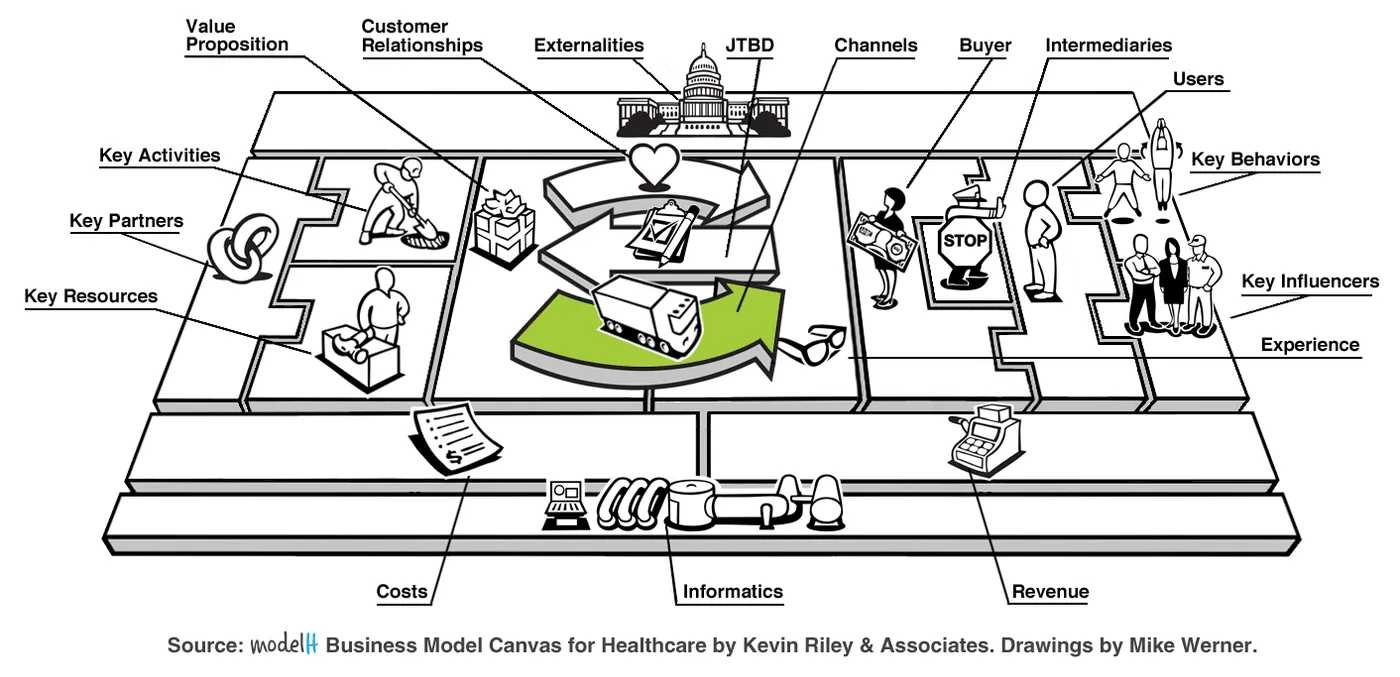
modelH Business Model Canvas: Channels
Channels are the ways (communication, distribution, or service) a company brings its Value Proposition to market. Development starts with the Buyer's Purchase Journey, the steps they take in deciding to buy. Healthcare models must also consider which Channels matter when a User actually uses the product. Then consider how Key Influencers and Intermediaries shape the outcome.
Market leaders help consumers navigate the maze of health options. Market disrupters remove the maze altogether. AI gives us the first realistic shot at doing that second one.
Questions for the Channels Block
- Through which Channels do your Customer Segments want to be reached?
- Through which Channels are you reaching them now?
- Do they use multiple Channels, and how?
- Which work best, and how do they fit into customer routines?
- Which are most cost-efficient?
- Are there Intermediaries in your Channels?
- How do you engage Key Influencers in them?
How to Build Your Channels
The path is simple. Pick your most important Customer Segments, build what matters most to them, and orchestrate an Experience across it.
- Identify the JTBD at each stage of the Purchase Journey.
- List all possible Channels, including those you do not control.
- Assess fit: product, customer, profitability, and goals.
- Map how customers actually move across them to find gaps.
- Create a Channel development plan with the people who own each one.
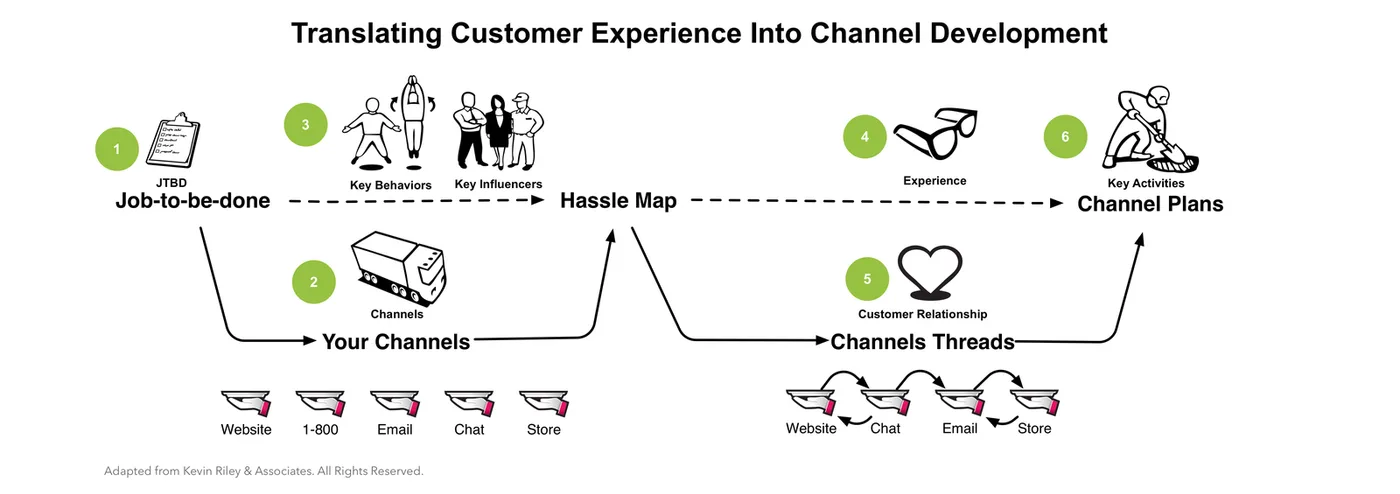
modelH: Translating Customer Experience Into Channel Development
You cannot be all things to all people. The book Winning at Retail, by Willard Ander and Neil Stern, argues that the best companies pick one "EST" position, such as cheapest or easiest, and defend it. When you pick a Channel, pick an EST.
Weigh three more factors: control over the experience, visibility into customer data, and customer preference for direct or indirect access.
Five Channel Shifts from AI
1. The AI Assistant Is a Discovery Channel
Consumers have moved there first. KFF reports 29% of Americans use AI monthly for health information. Meanwhile, Rock Health found that provider-specific chatbots have under 5% adoption, while ChatGPT alone has a far larger share. The patient's next step may begin in a window you do not own. Your old search playbook does not fully cover this. Be findable and accurate there.
2. The EHR Is a Distribution Channel, and a Gatekeeper
For clinicians, if it is not in the workflow, it does not exist. Now that EHR vendors ship their own AI and agent tools, they are both your channel and your competitor. Understand what that means before you bet on their marketplace.
3. Agents Will Buy and Book
When software acts for a person, your Channel must work for a machine as well as a human. That means clean APIs, structured data, clear prices, and clear rules. Prior authorization APIs required of impacted payers by January 1, 2027 are one early piece of these rails.
4. Every Service Channel Can Be a Conversation
Voice and chat agents can now handle much of the routine traffic in contact centers. A cost-efficient channel can suddenly also be a good one. Measure resolution rather than deflection.
5. Sales Itself Changes
Buyers use AI to research you, and your team uses AI to reach them. Expect a flood of automated outreach, and expect trust to shift toward references, proof, and people Buyers already know. Life sciences commercial teams should note this especially, because a health professional may ask an AI about your therapy before they ever ask your rep.
Do Not Forget Who Is Left Out
Older and sicker people, who drive much of the cost, have often been the last to adopt new channels. I made that point about mobile years ago. Do not assume AI solves it. Keep the phone and the person where your Customer Segment needs them, or you will create a two-tier system.
New Questions for 2026
- What happens when someone asks an AI assistant about the problem we solve?
- Which platforms control our access to customers, and what is our plan if they compete with us?
- Is our Channel usable by an agent?
- Which customers would be left behind by an AI-first Channel?
What is Next?
Next, we look at how to thread these Channels together.
to your health,
Kevin