
A better experience comes from immersing your customer in an orchestrated journey, then listening at each moment of truth. Three tools help you design one, and none of them requires a design degree.
Journey Mapping
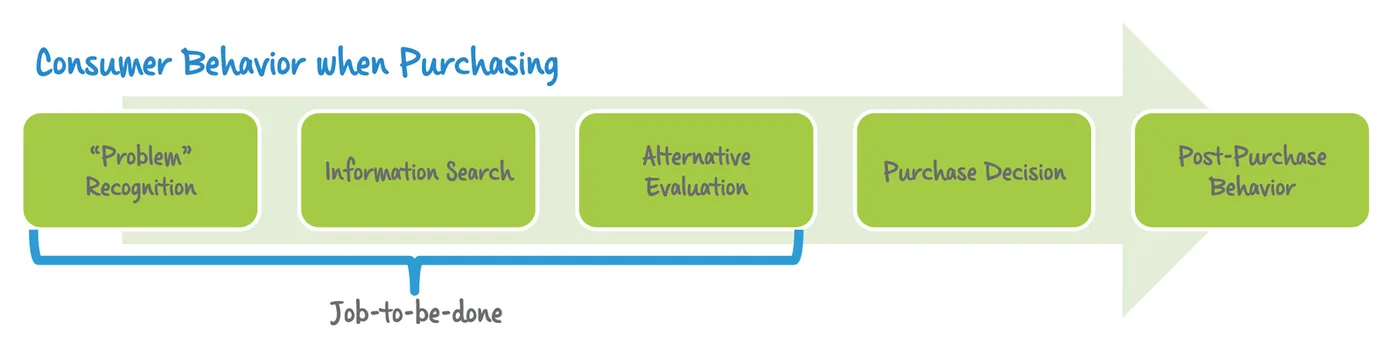
modelH: Consumer Purchase Journey
A journey map is a simple diagram of the steps a customer goes through with your company, whether that is a product, a retail visit, or a clinical encounter. In healthcare, map the purchase and the use. Too many companies spend their effort on the sale and ignore what follows.
For each stage, capture four things.
- Actions: what is the customer doing?
- Motivations: why keep going, and how do they feel?
- Questions: what is uncertain or confusing?
- Barriers: what stands in the way?
Then map what your company does at each stage. Think of two axes. The horizontal is the customer's path. The vertical is who inside your company and your partners enables it: those working directly with the customer, those who support them, and those running systems underneath.
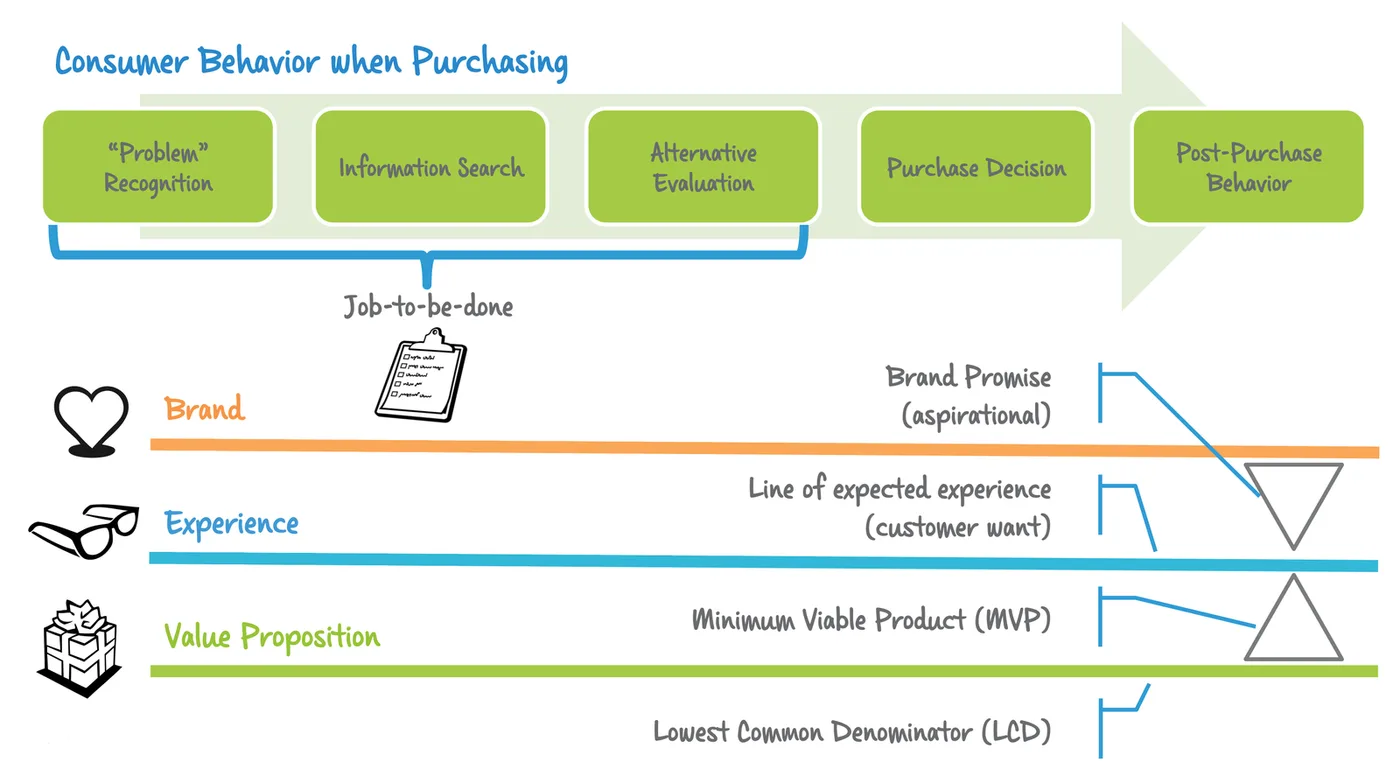
modelH: Consumer Behavior when Purchasing
Hassle Maps
Customer experience includes gains and pains. Pains that require workarounds are hassles, and they create extra work for customers and cost for you. Audit each channel and JTBD for them.
Zero defects are impossible, so design for quick recovery. The company should be the one to notice a hassle and reach out first. Weigh the cost of each fix against the value it adds to the relationship, and use that to set priorities. Also find moments to over-deliver. Those "bonuses" add fuel.
Storyboards
A storyboard shows a sequence of events in pictures and words, like a comic book. It brings a Persona and their JTBD to life. People who skim your requirements document will read a comic.
Draw the good path and the bad path. For AI, always draw the scene where the system is wrong. What does Sarah see? What does she do next? Who notices? If you cannot draw it, you have not designed it.
Service Blueprints
A service blueprint builds on the journey map. It shows the points of customer contact, physical evidence, and the supporting systems needed underneath. It gives the organization a common view of the service and its processes.
For AI, add a new lane to the blueprint called the autonomy line, marking for each step:
- Automated: AI completes it, with sampling and audit.
- Assisted: AI prepares it, and a person decides.
- Human: a person does it, and AI stays out.
Then ask four questions at each AI step. What data does it use? What happens when confidence is low? Who is accountable? How does the customer reach a human?
How AI Helps with the Tools
AI is useful for this work. It can mine call transcripts, messages, and reviews for the real journey rather than the one on the wall. It can find hassles nobody reported, draft storyboards and prototypes, and flag where data does not line up.
Here is a warning. AI can also produce a very polished map of a journey no customer has ever taken. Validate it. Sit in the waiting room. Listen to the calls. Call your own 800 number.
Doing the Work
- Choose one Persona and one JTBD.
- Build the map from real data and interviews.
- Mark hassles and bonuses, then score each by value and cost.
- Draw the storyboard for the good path and the failure path.
- Blueprint the priority moment with its autonomy line.
- Test with customers and front-line staff.
- Measure the result, then repeat.
New Questions for 2026
- Where is the customer already using outside AI on this journey?
- At which steps should AI never act alone, and why?
- What is our failure path, and have we tested it?
- Did our front-line staff help draw this?
What is Next?
Next, we turn to Channels.
to your health,
Kevin