
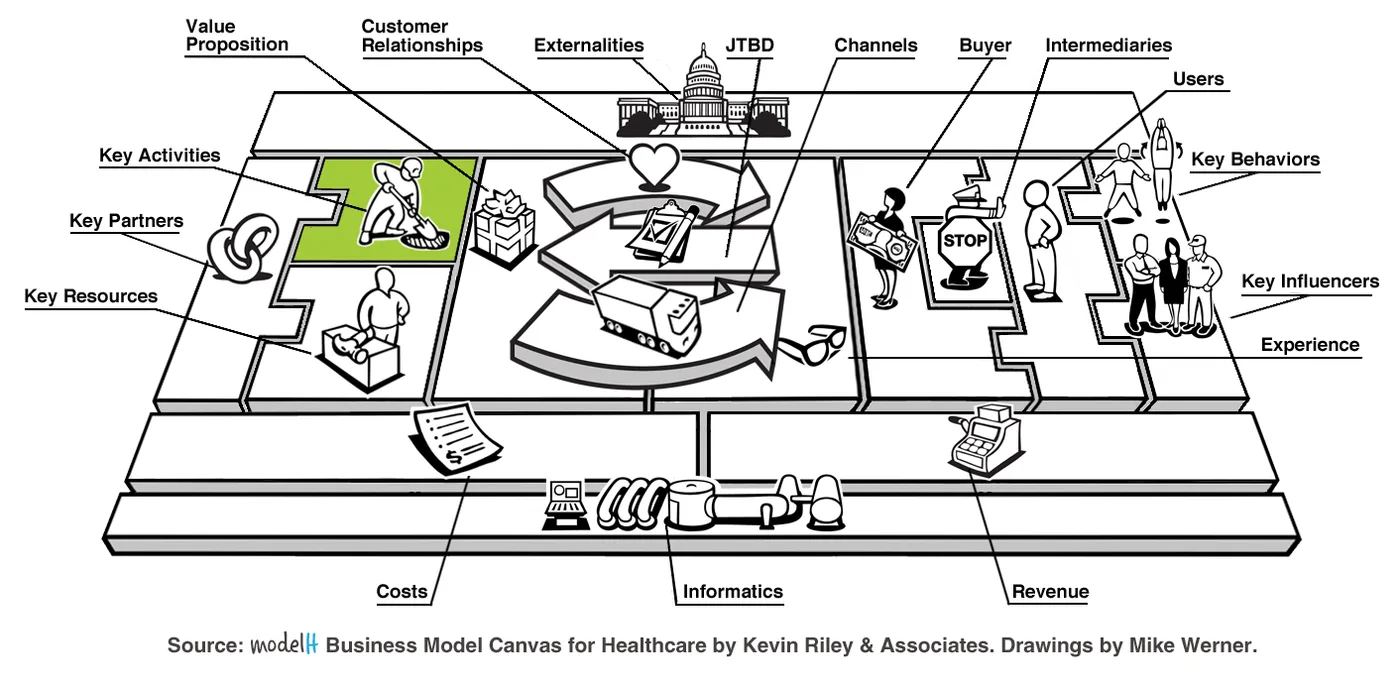
modelH Business Model Canvas: Key Activities
Key Activities are the most important tasks required to create the Value Proposition. There are plenty of ways to waste time doing the wrong things as your work scope creeps. So define the work, and then stick to only what is necessary.
Questions for the Key Activities Block
- What Key Activities do our Value Propositions require?
- What Key Activities do our Channels require?
- What Key Activities do our Customer Relationships require?
- What Key Activities do our Revenue streams require?
- Which Key Activities drive our Experience?
- How do we manage Value Proposition creation?
Do Only the Right Key Activities
I advocate applying Lean Startup rigor to everything, including technology, process, and all business functions. The work required for a build should be only what supports the Minimum Viable Product.
Think of a product as form and function. Function is what it does. Form is how it does it. Your customer expects a certain form, which we discussed under Experience, so include what that requires. On function, build only what solves the JTBD. If your product is all style and no substance, you lose customers. If its substance far exceeds their needs, the extra value goes unrealized and may leave them confused.
And do not forget that you are running a business. Compliance, filings, and finance are Key Activities too. If you do not list them, you will find out too late, and it will shut you down or cost you dearly.
How AI Changes the Work
The mistake I see is treating AI as a thing to sprinkle on existing tasks. Paving the cow path gets you a faster cow. Redesign the work.
Step 1: List the Work
Write each Key Activity as an actual flow of tasks, not a department. Include handoffs, waiting, rework, and the unofficial workarounds that keep the place running.
Step 2: Sort Each Task
- Automate when work is high volume, rules are clear, errors are detectable, and consequences are recoverable.
- Assist when judgment matters, and AI can prepare, draft, or check.
- Keep human when consequences are severe, trust is the point, or a license requires it.
- Eliminate when the task exists only because the old process was bad. This is often the biggest win.
Step 3: Add the New Key Activities
AI creates work. Budget for it.
- Evaluation: testing accuracy on your data before launch and after every change.
- Monitoring: watching for drift, bias, and failure in production.
- Human review: sampling output and handling escalations.
- Governance: approvals, documentation, audit trails, and incident response.
- Data work: access, quality, consent, and de-identification.
- Change management: training and redesigning jobs.
A growing share of the work shifts from producing to supervising. Keep in mind that people get bored and stop checking. A human in the loop is not a safety plan unless you have designed for that.
Where the Evidence Stands
Be clear-eyed. McKinsey found gen AI implemented by 52% of surveyed clinical care organizations and 34% of payers, with multi-agent systems at 18% and 10%. Many healthcare organizations are still early. Work with many exceptions, changing rules, and data from several systems remains hard to automate. Prior authorization is a good example.
In life sciences, AI is speeding up parts of discovery, and one review found late-stage trial duration has not consistently shortened. When the slowest step is biology or a regulator, speeding up another step may not change your total timeline. Find your actual constraint before you celebrate.
New Questions for 2026
- Which Key Activities should we automate, assist, keep human, or eliminate?
- What new work does AI create for us, and who owns it?
- What is the actual constraint in our process?
- If we started today, would this activity even exist?
What is Next?
Next, we look at who and what performs this work: Key Resources.
to your health,
Kevin