
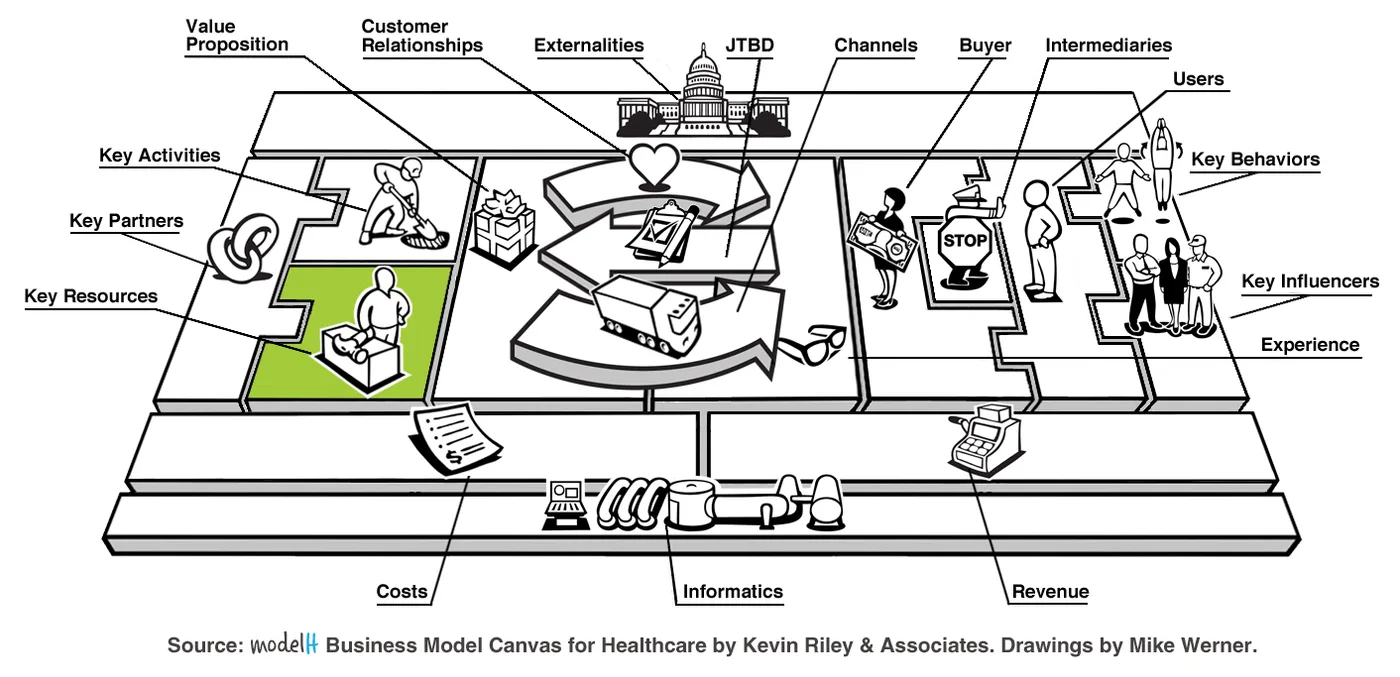
modelH Business Model Canvas: Key Resources
Key Resources are the internal actors required to deliver the Value Proposition. They can be physical, intellectual, human, or financial. For any company, labor is usually among the most significant drivers of cost. Hire too many people and you carry unnecessary cost. Hire too few and you get overworked people who cannot deliver and eventually leave.
It takes one person to come up with an idea. It takes a team acting in concert to make it a business.
Questions for the Key Resources Block
- What Key Resources do our Value Propositions require?
- What do our Customer Relationships, Experiences, and Users' Key Behaviors require?
- What do our Channels, Partners, Intermediaries, and Influencers require?
- What do our Revenue streams require?
- What level of Key Resources will our Cost model support?
- What employment Value Proposition can we offer?
- What staffing model ensures the right amount of resources?
- What sourcing model gets us the right level of talent?
Planning Your Resources
List the outcomes tied to each phase of your Value Proposition. Make assumptions about growth, seasonality, and demand, and estimate the people required. Define work clearly, since the job description remains the common language for sourcing talent. Then see how each role complements or duplicates others. Your Key Resources should mirror your Key Activities, and they should understand the whole business model.
How AI Changes the Mix
The Staffing Model Has a New Line
Some Key Activities can now be done by agents. Put them on the plan with an owner, a cost, a quality standard, and a human accountable for the result. That is the part of the AI-native company most worth copying. Treat AI capacity like you would a team, and manage it with the same seriousness.
The Skills Shift
- Domain experts who can supervise AI become the most valuable people you have. Nurses, coders, and researchers know when the output is wrong.
- Evaluation and quality skills move from a specialist function to a core one.
- Clinical informatics and data governance move from the back office to the center.
- Workflow and change leaders determine whether anything is actually used.
The Apprenticeship Problem
Here is a problem few people are talking about. If AI does the junior work, how do people become senior? Healthcare depends on hard-won judgment. A coder learns by coding, and a clinician by writing notes and thinking through cases. If you remove that work, plan on purpose for how the next generation will build judgment. Otherwise, you will have nobody left who can check the machine.
Your Workforce Has a Vote
Healthcare has real labor shortages, and clinician burnout is one of our Quintuple Aims. That is a real opportunity for AI. Still, the same tool can relieve a nurse or be used to add ten more patients to her load. If people believe AI is coming for their jobs, they will not teach it what they know. Say clearly what happens to saved time, and share the gains.
Your Real Intellectual Resources
The models are mostly rented. These resources are yours: proprietary outcomes data, clinical protocols, labeled evaluation sets, the workflows you redesigned, and the trust of your customers. Protect them. Check your vendor contracts to see who gets to learn from your data.
The Same Test for Life Sciences
Some of the largest pharma companies are building their own computing and AI capabilities while also buying from AI-native companies. The build-versus-buy decision comes down to a simple question: is this capability how you win, or just how you operate? Own what differentiates you, like your data, your target biology, and your scientists' judgment. Rent the rest.
New Questions for 2026
- Which work will agents do, who owns the result, and what does it cost?
- Which skills become more valuable and which less?
- How will junior people build judgment?
- What happens to the time AI saves?
- Which intellectual resources are truly ours?
What is Next?
Next, we look at external actors: Key Partners.
to your health,
Kevin