
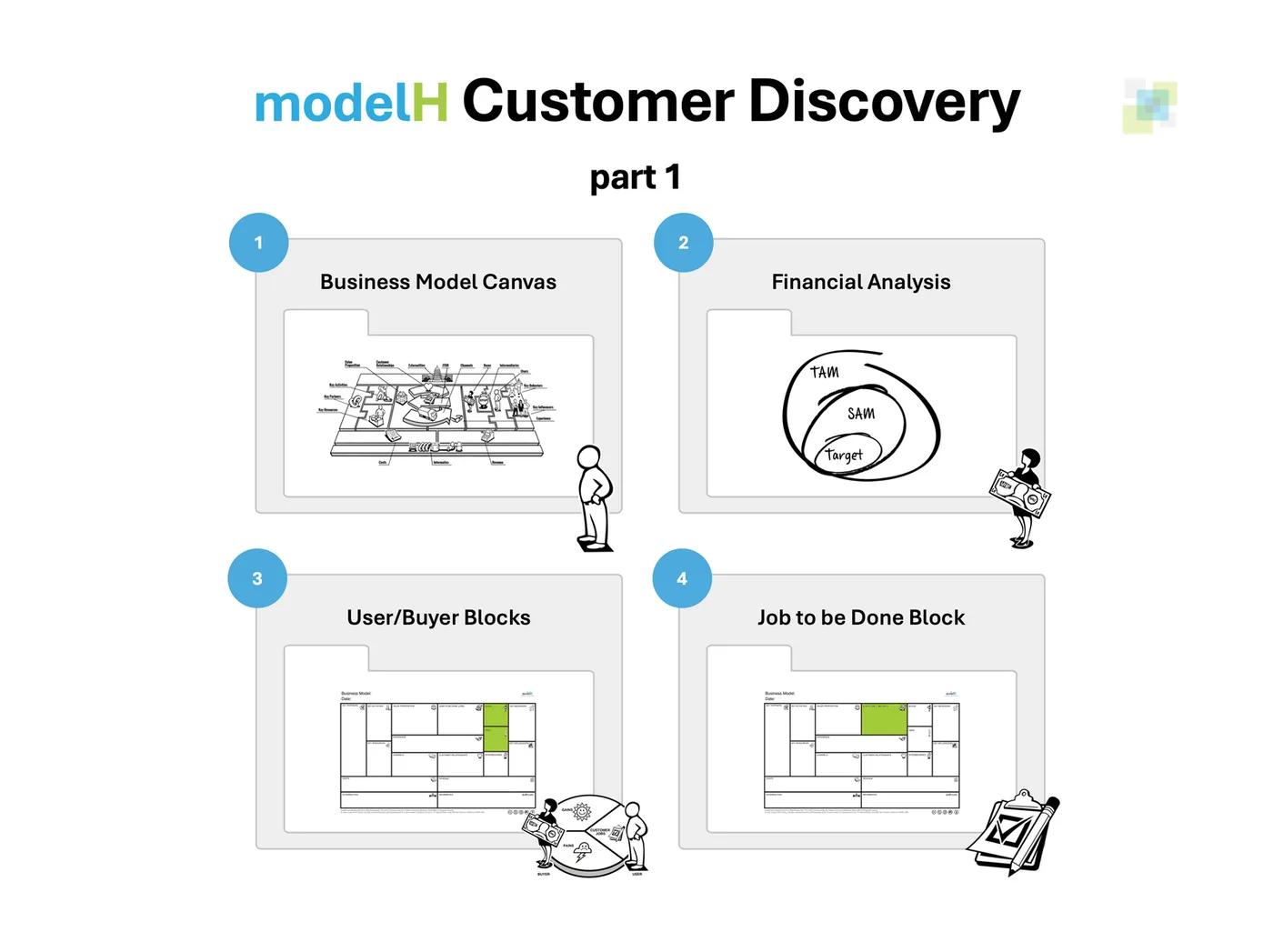
modelH Customer Discovery, part 1
A hypothesis I believe to be true, since I made it up: a customer's attitudes may stay the same, but their needs and behaviors never do. Grouping people by age, race, or gender tells you nothing about their needs, wants, or feelings. Even segmenting by attitude assumes people can be classified for longer than a moment in time.
Let me tell you about a friend of mine. He is a stellar runner who thinks a 10K is a warm-up. On running, he wants facts and choices from the best experts. Then he learned that his family history of hypertension had found its way into his own life. On blood pressure, he was uninformed, concerned, and in need of serious help. He is one person, and he was two very different customers.
Four Ways to Segment
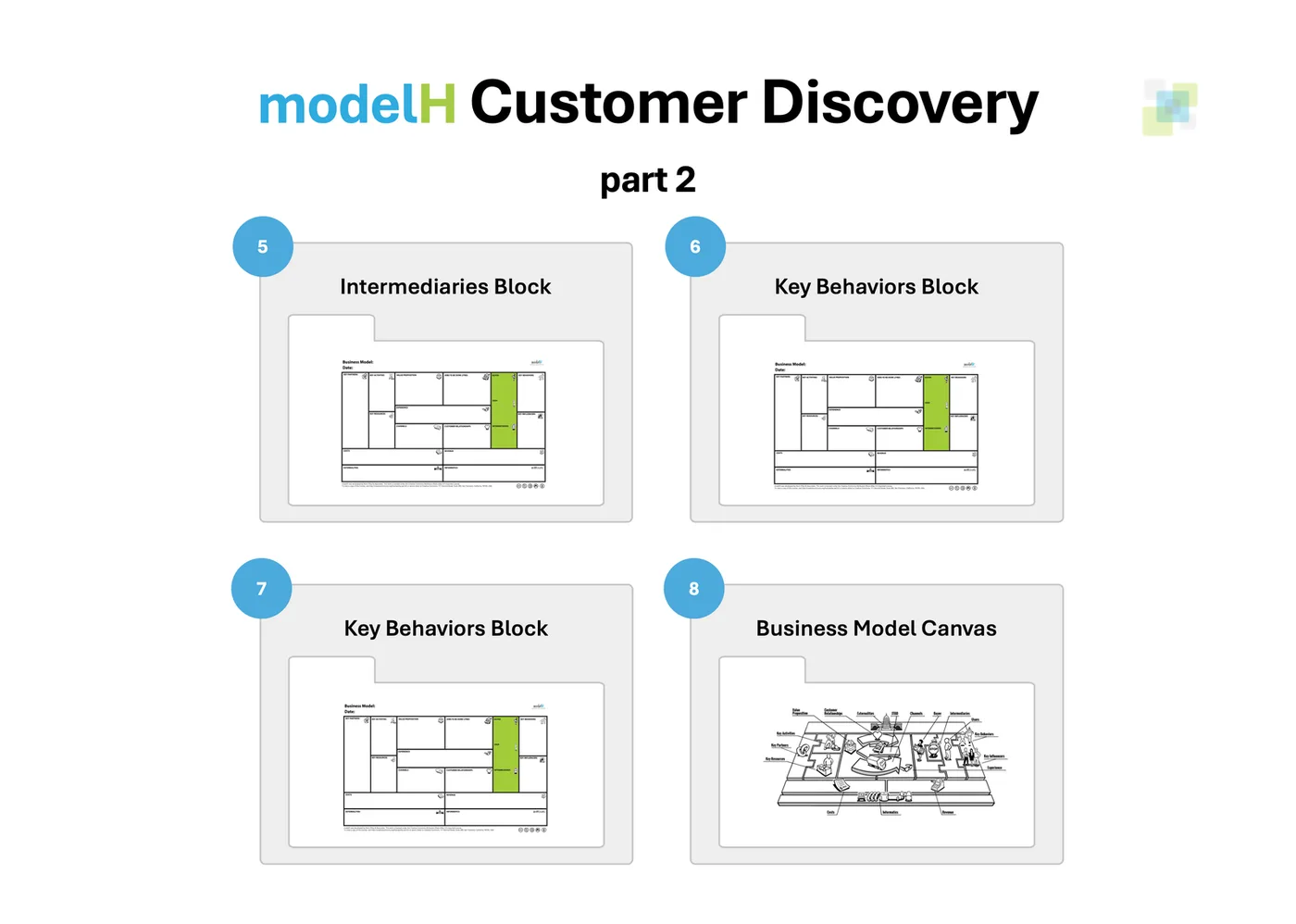
modelH Customer Discovery, part 2
In addition to the models Osterwalder lists, modelH uses four healthcare-specific ones.
- Archetype (Behaviors): needs, attitudes, and behaviors around healthcare decisions. Commercial frameworks like VALS sit here.
- Life Condition (Health Status): health concerns such as diabetes or high blood pressure. Seniors and 30-year-olds rarely like the same music (unless it is Bruce Springsteen!), but a 30-year-old diabetic acts much like a 65-year-old diabetic, and a 65-year-old health nut acts more like a 35-year-old health nut.
- Life Stage (Demographics): milestones such as birth, parenthood, and retirement, each with its own healthcare jobs.
- Life Style (Job-to-be-done): what a person is trying to accomplish right now. I developed this approach while building a new healthcare company. It accepts that people are multi-faceted, and that the right segment size is often N of 1.
In 2024 I wrote that Life Style segmentation was the best of these, and the hardest. I still believe that. What has changed is the cost. A language model can now read what a person says and writes and infer their current job, then adjust the response in the moment. The segment becomes a state a person is in today, rather than a label that follows them around.
There is a catch. Inferring health needs from personal data raises real privacy and bias concerns, and AI systems can work unevenly across populations. Test your segmentation across the groups you serve. Be transparent about what you use and why. A nudge that feels personal to one customer can feel like surveillance to another.
Defining Customer Personas
Personas are detailed descriptions of imaginary people built from specific data about real people: "Sarah, the busy working mom," or "John, the tech-savvy Care Manager." They should be focused on your primary target, not exhaustive, and always evolving. Explore these questions.
- Who are your primary target customers?
- What products and services are they seeking from you?
- What drives their perception of value?
- How do they determine whether they are receiving value?
- Where else will they look for that value?
Three Stages of Persona Canvassing
- Category Typing. Brainstorm groupings by Segment (payer, provider, managed service organization), Role (care manager, quality analyst), and Goal (lower acquisition costs, better HbA1c scores).
- Affinity Diagramming. List facts and assumptions, place them under each category, label the clusters, and debate them.
- Persona Outlines. Capture each User and Buyer on one page with your assumptions clearly marked.
Who are the Healthcare Personas?
I won't enumerate them all (maybe someday), but here are a few key ones.
- Consumer-Patient-Member: someone seeking medical attention in a hospital, clinic, or home. They typically cover costs through health insurance, where they are known as members, by paying out of pocket, or through both.
- Provider: anyone or anything that delivers medical care or treatment. Examples include doctors, nurse practitioners, midwives, radiologists, laboratories, hospitals, urgent care clinics, and medical supply companies.
- Payer: anyone or anything that funds medical services. Health insurers are payers, not caregivers, and they often have provider networks their members can use.
- Managed Service Organization: a company that handles the non-medical side of running a practice so doctors can focus on patients. Hospitals, doctors, or investors can own one.
AI Personas Are Hypotheses
You can now ask a model to play your Persona and interview it. It is useful for pressure-testing an interview guide, finding questions you forgot, and spotting weak logic before you spend a customer's time.
It is not validation. A simulated Persona reflects its training data and your prompt, so it tends to be agreeable and average. Healthcare's real insights tend to live at the edges. Mark anything AI-generated as an assumption until a real person confirms it.
Add two new Personas to your list where they apply: the clinical or compliance reviewer who must sign off on AI, and the AI-primed patient who has already consulted a chatbot.
New Questions for 2026
- Could we segment by a person's current job instead of a fixed label?
- What data would that require, and have customers agreed to it?
- Does our segmentation perform equally well across the populations we serve?
- Which parts of our Personas came from real people and which from a model?
What is Next?
Next, we go deep on Jobs-to-be-Done.
to your health,
Kevin