
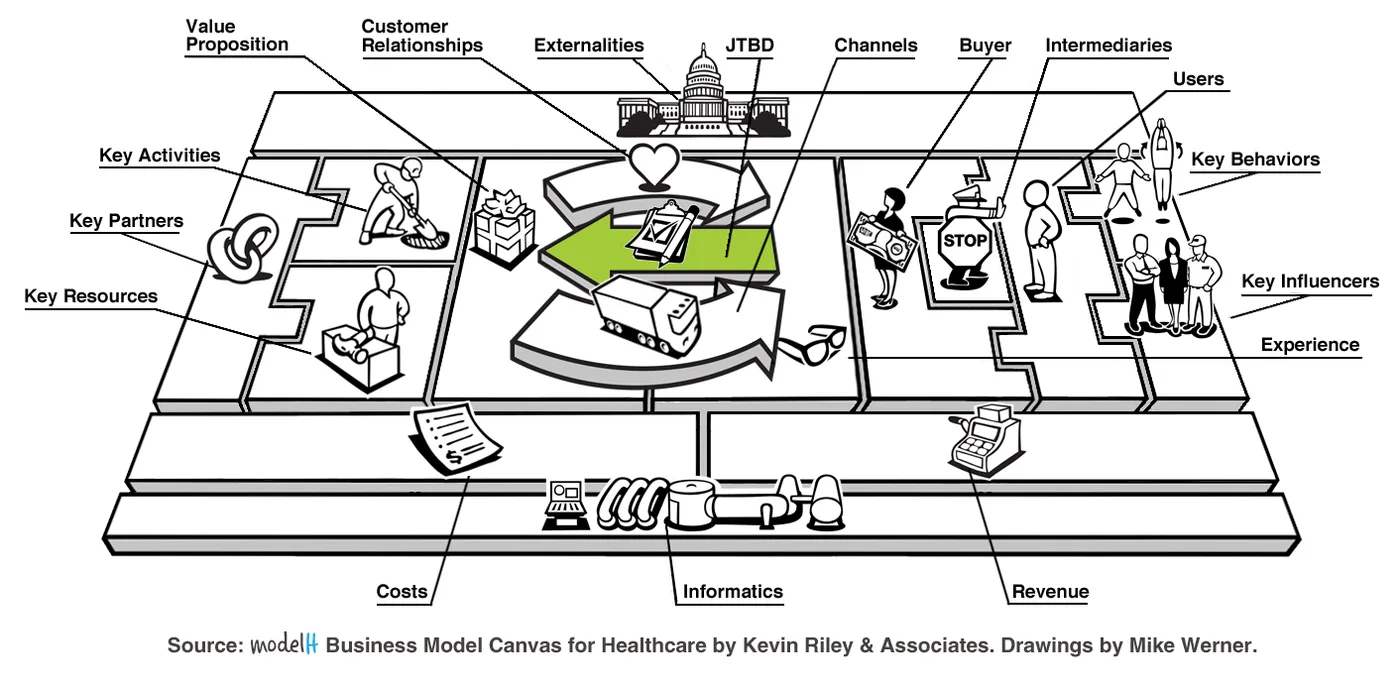
modelH Business Model Canvas: Jobs to Be Done
A job to be done is a high-level goal that a person is trying to accomplish. It may be a task to complete, a problem to solve, or a need to satisfy. The idea is simple, with profound implications: stop thinking about your product and start thinking about what your customer is trying to do.
Clayton Christensen noted that people do not want drill bits. They want holes. Actually, they want what the hole gets them: a happy spouse, a paid invoice, or artwork on the wall. AI vendors should tape this to their monitors. Nobody wants a model. They want the hole.
Why Health JTBD Are Hard
The most important JTBD in healthcare is health itself, and it spans physical, financial, emotional, social, occupational, and other dimensions. A patient who says their job is to "get well" may not know what that takes. For someone with Type 2 diabetes, it can mean a lifelong commitment to monitoring, eating well, exercise, and possibly medication. A Value Proposition short of that fails them.
Healthcare also has many interdependent jobs.
- Member: I want to understand my coverage.
- Patient: I want to be an active member of my care team.
- Provider: I want to know quickly where my patient's care stands.
- Payer: I want my team delivering appropriate care at the lowest cost.
- Employer: I want benefits that keep my employees healthy.
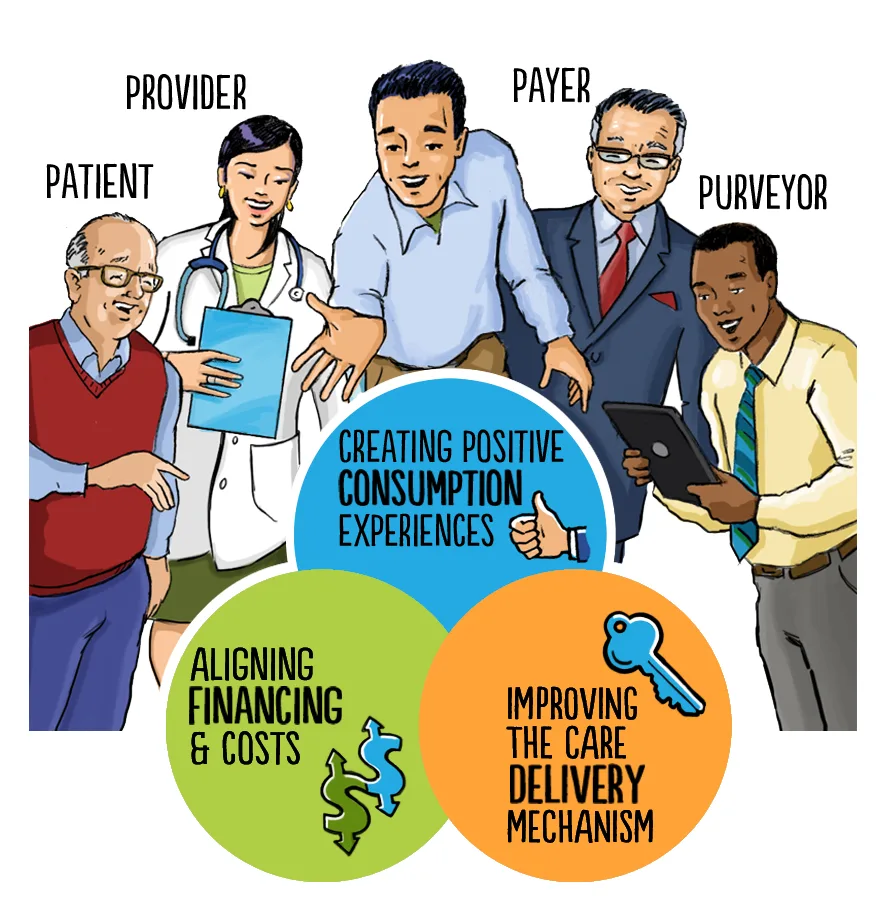
modelH: Healthcare Ecosystem
Writing a JTBD
Use this format: When [situation], I want to [motivation], so I can [expected outcome]. Add pains (without [pain reliever]) and gains (with [gain creator]).
Every healthcare JTBD also has two parts. The utility JTBD is the goal. The mentality JTBD is the set of Key Behaviors a person needs to reach it. I find this distinction matters even more now. AI is very good at utility: explaining a bill, finding a provider, drafting an appeal. It is much less proven at mentality: helping someone change a habit over ten years.
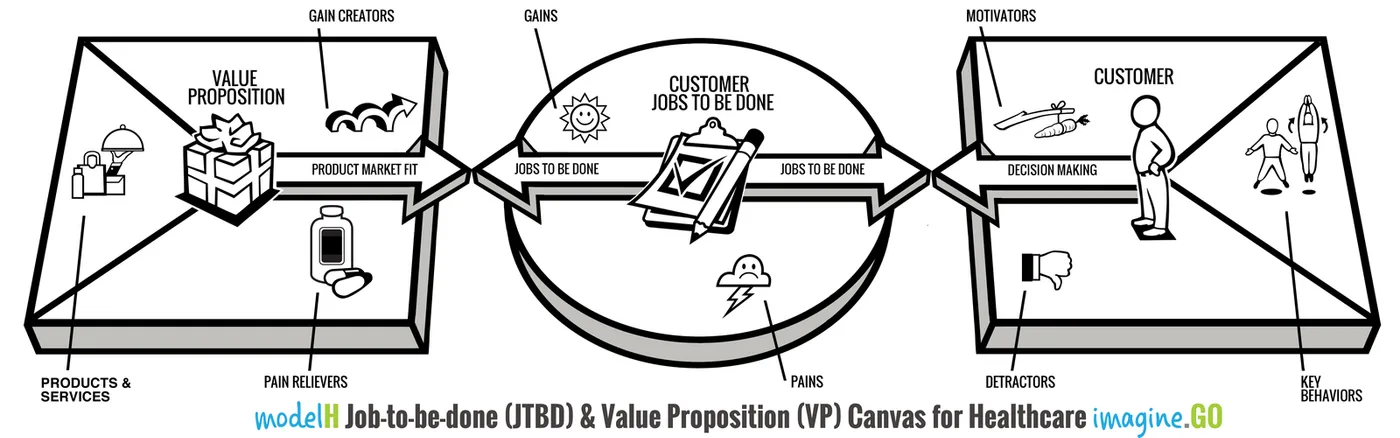
modelH JTBD Canvas
How AI Changes the Job
AI splits every job three ways, and you should map each step of the JTBD accordingly.
- Done for them: the task goes away, like prior authorization paperwork or chart summaries.
- Done with them: AI helps the person think and decide, like preparing for an appointment.
- Still theirs: the person must act and take responsibility, like taking the medication or making the clinical judgment.
The survey data says patients have already started re-routing their jobs. In one report, about a fifth of people used AI to understand what their health plan covers, and another fifth to make sense of a bill or explanation of benefits. If your Value Proposition was explaining benefits, your competition just changed.
The risk runs the other way too. Mount Sinai researchers reported in Nature Medicine that ChatGPT Health under-triaged about half of the emergency cases in a test using simulated patients. When a job has high stakes, "done for them" can hurt someone. That gap is where a responsible business model finds its opening.
Defining Pains and Pain Relievers
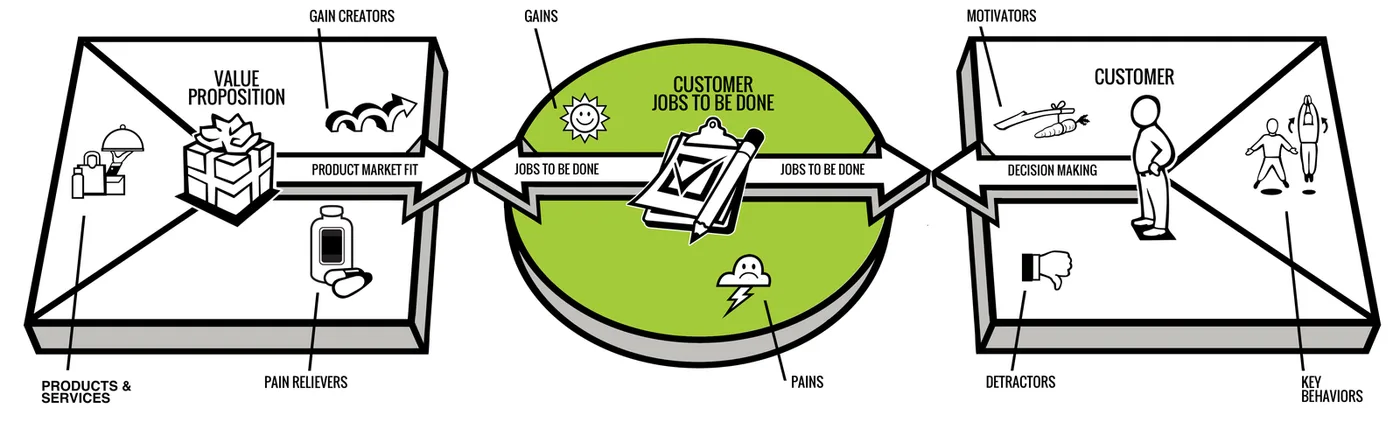
Pains describe anything that annoys your customers before, during, and after a job, or prevents them from getting it done. They also include the risk of a bad outcome. Try to understand these aspects.
- Cost and effort: How do they weigh price, time, and results? Which solutions seem too expensive or too much work?
- Frustrations and annoyances: What causes frustration, inconvenience, or confusion? What is missing or underperforming?
- Difficulties and challenges: What is hard to understand or use? What do they resist, and why?
- Negative experiences and risks: What social anxieties concern them? What financial, technical, or social risks do they see?
- Worries and concerns: What keeps them up at night about this job?
- Barriers to adoption: What stops them from adopting your Value Proposition, such as upfront cost or a learning curve?
- Common mistakes: How do customers commonly misuse your products or services?
Defining Gains and Gain Creators
Gain Creators are a roadmap for your Value Proposition. They show how you deliver benefits beyond function, including social standing, emotional satisfaction, and cost savings.
- Adoption: How do they want to save time, money, and effort? What would make their work or life easier, and what makes a new solution easy to adopt?
- Expectations: What outcomes do they expect, and how do they define "better"? What would outperform existing solutions and delight them?
- Impact: What would enhance their social status or image? What specific desires do they want fulfilled?
Questions for the JTBD Block
- JTBD: I want to … action words + object of action + context.
- Current Approach: How do they solve it now?
- Benchmark: What do they compare that approach to?
- Performance Criteria: How do they judge effort and experience?
- Barriers: What prevents them from trying something different?
- Behaviors: What Key Behaviors drive completion?
- Data: What data is needed to complete the job?
- Value: What creates value in their minds?
- Pains: What do they want to avoid?
- Gains: What do they want to experience?
Problem-Market Fit and Treasure Mapping
Problem-Market Fit asks: are we solving the right problem for a big enough market? Answer that before you ask about Product-Market Fit.
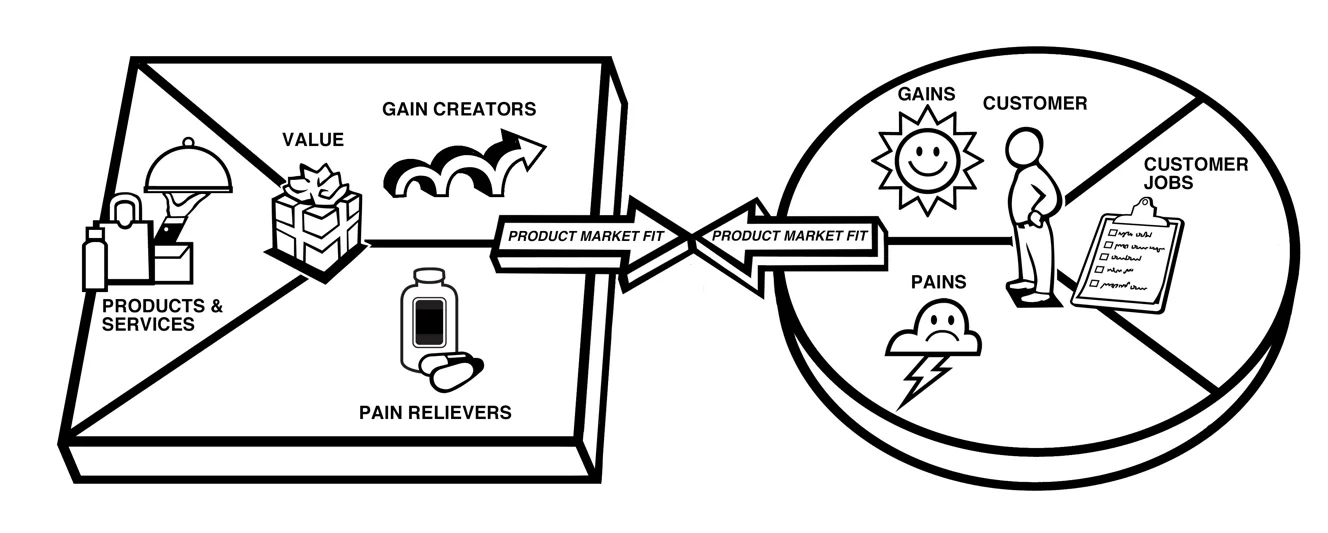
modelH Value Proposition Canvas
I use Treasure Mapping to build a JTBD. Mark where the User is now ("You are here") and where they want to end up ("X marks the spot"), then the stops between. Most Users cannot see all the points on their own map, so your Value Proposition must account for that. AI can help draw a map for one person. Your job is to make sure it is the right map.
Problem-Feedback Interviews
Get out of the building. Interview about 15 to 50 ideal customers, with at least 15 per Persona, adapted from Ash Maurya's Running Lean. You want three things: the problem and its top pains and gains, the existing alternatives, and a viable Customer Segment.
Ask about behavior, not opinions. Do not pitch. Let them talk. In 2026, add these questions to the guide: Have you tried using AI for this? What happened? What would you not trust it to do?
AI can transcribe and tag every interview, and that is a real gift. But read the transcripts yourself, at least the first ones. Models smooth away the odd remark that turns out to be your whole business.
Sample Interview Agenda
- Introduction: set the stage (1 min)
- Demographics: test the Customer Segment (5 min)
- Story: set the problem context (2 min)
- Ranking: test the problem (7 min)
- Exploration: test the problem (13 min)
- Conclusion: wrap up and ask (2 min)
- Documentation: record and transcribe (thank you, AI!!!)
New Questions for 2026
- Which steps of this job are done for them, done with them, or still theirs?
- How are they using AI to do this job today?
- What would be dangerous to automate, and how do we know?
- If AI does the utility job for free, what mentality job is left for us?
What is Next?
Next, we look at Intermediaries, where AI is about to cause a lot of trouble.
to your health,
Kevin